LearningFirst for Educators
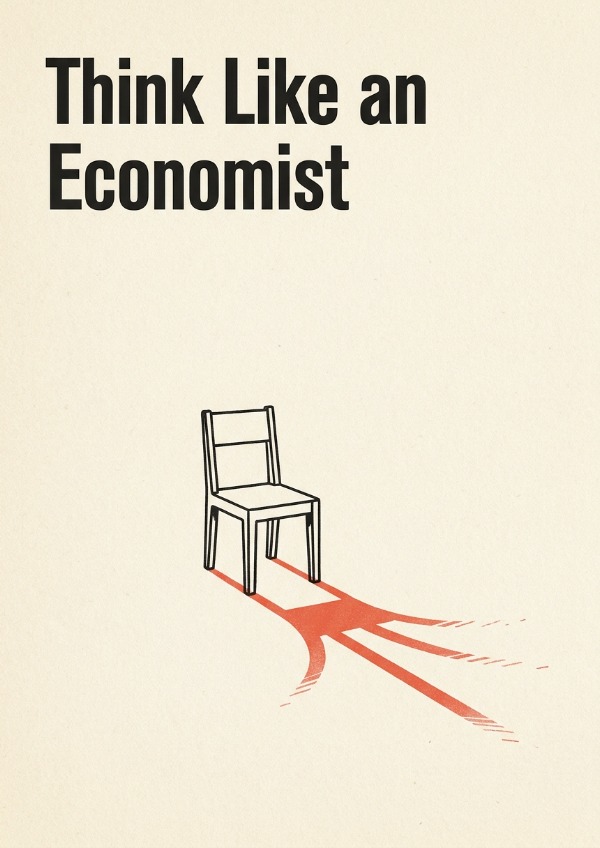
Think Like an Economist
A teaching program that develops the capacity to think like an economist — to see incentives, trade-offs, opportunity costs, and unintended consequences in everyday decisions and public policy. Students learn the analytical toolkit that economists use, applied to questions they actually care about.
An educator-led course, supported by structured reading and the LearningFirst learning platform.
About the program
This course covers six modules on economic thinking: scarcity and trade-offs, incentives and behaviour, markets and prices, externalities and public goods, macroeconomic forces, and economic reasoning applied to contemporary issues. Educators guide students to think in terms of costs and benefits, marginal analysis, and systemic effects rather than isolated events. Each session combines guided reading with economic analysis exercises, policy debates, and case studies that connect theory to lived experience.
Curriculum & takeaways
Built on the core textbook Think Like an Economist
What learners take away
- 5cost questions that expose what a decision really costs before you commit to it.
- 5incentive diagnostics for predicting how people will respond to a target, guarantee, or pay scheme.
- 4system-level tests — seen vs. unseen, equilibrium, incidence, and composition — for following effects past the first round.
- 5game-structure levers for turning a race to the bottom into cooperation.
- 1seven-question economist's checklist to run on any live decision.
Curriculum structure
6 modules · 10 key concepts01 Scarcity and the True Cost of Choice
Every yes is a no to something else — the economist's starting point for every decision.
02 Incentives: The Hidden Wiring of Behavior
People respond to the rules they face — including the rules nobody meant to write.
03 Prices, Markets, and Signals
A price is compressed information — and markets are machines for spreading what no single person knows.
04 Seeing the Whole System
The first effect is rarely the last one — follow the chain until things settle.
05 Strategy and Interaction
When your best move depends on everyone else's, you're playing a game — so learn its structure.
06 The Model Meets the Real World
Models are maps — the skill is knowing which one fits the terrain, and how to test it against evidence.
Core understanding
Economics is the study of choice under scarcity. Every yes is a no to something else, so the useful question about any decision is always "compared to what?"
The cost of a choice is the best alternative it displaced. Opportunity cost rarely appears on a receipt, and decisions improve the moment it is counted.
Decisions live at the margin. Asking what the next hour, dollar, or hire adds turns all-or-nothing debates into precise, answerable questions, and sunk costs drop out of the calculation.
People respond to the incentives they actually face. Metrics, guarantees, and pay schemes invite predictable behavior, including the gaming nobody intended, so the response is worth predicting before the rule is written.
Prices are compressed information. They coordinate strangers, reveal where scarcity lives, and when suppressed or missing, reappear as queues, shortages, and costs billed to bystanders.
Nothing stops at the first round. Seen and unseen effects, equilibrium, incidence, and the fallacy of composition all ask the same question: what happens after everyone adjusts?
When outcomes depend on others, the structure of the game decides the result. Repetition, commitment, signaling, and well-designed rules turn self-interest into cooperation.
Models are maps, and evidence decides which one fits. Economists pick the simplest model that captures the forces at work, add behavioral realism where it matters, and use natural experiments to separate cause from correlation.
Questions students will explore
- Why does an hour-long meeting with eight people cost a full working day, and what else could that day have bought?
- Why do targets that reward people so often end up rewarding the wrong thing?
- If you are better at every task than your colleague, why do you both still gain when you specialize?
- When a new fee lands on a deal, why does the person who can walk away most easily almost never pay it?
- How did communities from Swiss alpine meadows to Japanese village forests keep shared resources healthy for centuries?
Key concepts
- Opportunity Cost
- Marginal Thinking
- Sunk Cost
- Goodhart's Law
- Moral Hazard
- Principal–Agent Problem
- Comparative Advantage
- Asymmetric Information
- Tax Incidence
- Mechanism Design
Course-specific outcomes
Students will be able to:
• Apply opportunity cost and marginal analysis to personal and policy decisions
• Explain how incentives shape behaviour — including unintended consequences
• Analyse how markets coordinate information and allocate resources
• Identify market failures (externalities, public goods, information asymmetry) and evaluate policy responses
• Evaluate competing economic arguments using evidence and logical reasoning
• Apply economic thinking to contemporary issues (technology, environment, inequality)
Assessment & accreditation
LearningFirst connects course learning, assessments, results, and student records in one system. Where included, examination and accreditation services are supported by Extracurricular Activity Excellence International Pte. Ltd. (EAE), whose registered Singapore business activity is “Examination and accreditation agencies for education services” (SSIC 85502). Any award remains subject to the course’s stated requirements.
Demonstrate understanding
Students take LearningFirst’s course assessments to show what they have learned.
Earn a certificate
Students who meet the required standards receive a certificate identifying its awarding entity and assessment standards.
Record the achievement
A learning transcript documents assessment results as part of the student’s learning record.
Lasting value, beyond the course
Achievements students can carry forward
Certificates, earned credits, and learning transcripts become lasting assets in each student’s learning portfolio—evidence of knowledge, effort, and achievement they can build on and present throughout their lives.
- Further study
- Professional development
- Future careers