LearningFirst for Educators
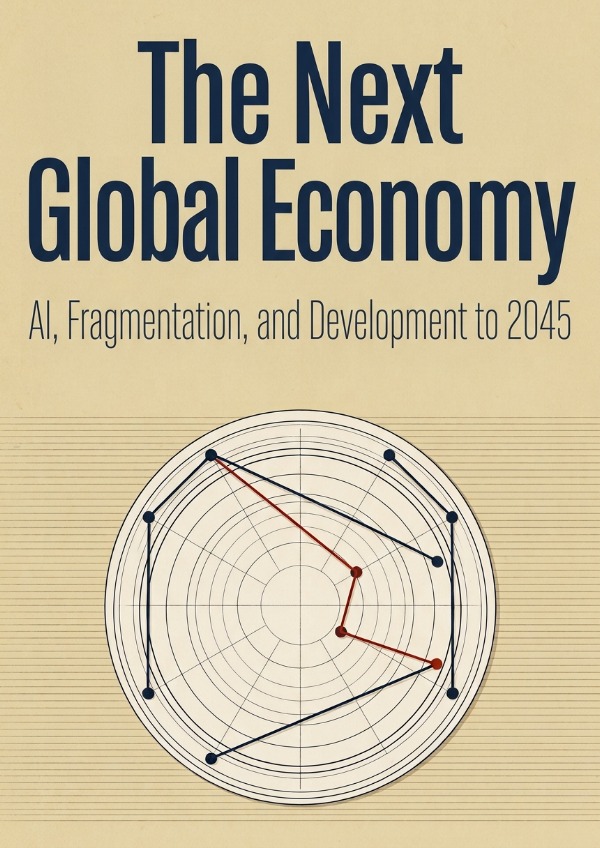
The Next Global Economy: AI, Fragmentation, and Development to 2045
Lead students beyond economic headlines to investigate how AI, trade, demographics, resources, and debt are reshaping the world—and develop their own evidence-based perspectives on its future.
An educator-led course, supported by structured reading and the LearningFirst learning platform.
About the program
Why is the world economy changing—and what could those changes mean for the next generation?
This educator-led enrichment course invites secondary learners to examine the forces shaping the global economy through guided reading, classroom discussion, case studies, and collaborative inquiry. The main collection provides a shared intellectual foundation, while you bring the subject to life through questions, local examples, debate, and student projects.
Across ten modules, students investigate issues including AI and productivity, changing trade relationships, industrial policy, China’s economic transition, demographic change, resource constraints, and development opportunities. They learn to connect these issues, compare competing explanations, and distinguish evidence from prediction.
The course culminates in a student investigation of a country, industry, or development challenge. Learners use the course’s frameworks to explain current conditions, explore alternative futures, and present a reasoned judgment.
For educators, the program offers an opportunity to develop a distinctive course that connects economics, technology, geography, and public affairs—and helps students think critically about the world they will inherit.
Curriculum & takeaways
Built on the core textbook The Next Global Economy: AI, Fragmentation, and Development to 2045
What learners take away
- 5structural forces — technology, fragmentation, demographics, resources, and debt — for placing any economic headline in context.
- 4scenario worlds built on two uncertainties, AI productivity speed and fragmentation depth, for stress-testing plans to 2045.
- 5country archetypes — technology leaders, connector economies, commodity exporters, aging manufacturers, and young low-income economies — for judging who gains under each scenario.
- 1signal dashboard of indicators, from productivity data to dollar share, for telling which future is actually unfolding.
- 3development paths — manufacturing, services, and resources — for assessing which ladders remain open to the Global South.
Curriculum structure
10 modules · 10 key concepts01 The Starting Line: The World Economy in 2026
What the shocks of the early 2020s left behind, and the frame for everything that follows.
02 AI as a General-Purpose Technology
Why the AI payoff may arrive late, unevenly, and in a few places first.
03 Globalization Rewired, Not Reversed
Testing the deglobalization story against the trade data.
04 The State Returns: Industrial Policy and Geoeconomics
Subsidies, sanctions, and screening as ordinary tools of economic policy.
05 China's Next Model
The end of the property engine and the bet on new productive forces.
06 People and Payoffs: Demographics, Work, and Distribution
Who will do the work of the next two decades, and who will keep the gains.
07 Energy, Minerals, Food, and Water
The physical economy beneath the transition, the data center, and the harvest.
08 Debt, Dollars, and the Money System
Who owes, who lends, and why the dollar still sits at the center.
09 Development Paths for the Global South
Which ladders remain open when factories need fewer workers.
10 Scenarios for 2035 and 2045
Four plausible worlds, the signals that reveal which one is arriving, and a model that holds across them.
Core understanding
The world economy is being rewired, not dismantled. Goods trade has stopped outgrowing GDP since 2008, yet it has not collapsed; flows are rerouting through connector economies, and services and digital trade keep expanding.
The 2020s reset the baseline. The pandemic, the 2021–23 inflation surge, and the fastest rate-hiking cycle in decades ended the era of near-zero real interest rates, and positive real rates now reprice public debt, corporate investment, and asset values.
AI is a general-purpose technology with a slow fuse. Like electricity and computing, its measured productivity payoff depends on firms reorganizing around it, and its gains are concentrated in a handful of firms and two countries.
The state is back as an economic actor. Subsidies, tariffs, export controls, sanctions, and investment screening have become ordinary tools, and their results depend on whether they build capability or merely bid up the price of the same factories.
China is changing engines while still setting world prices. The end of the property boom pushed it toward EVs, batteries, solar, and advanced manufacturing, and its scale in those sectors reshapes trade frictions everywhere.
People and resources set hard limits. Aging workforces in East Asia and Europe, a working-age surge in Africa and South Asia, and the physical demands of the energy transition and AI data centers bind what money and policy can do.
Debt and the dollar anchor the system, under strain. High public debt, slow sovereign restructurings, and new payment rails test the monetary order, while network effects keep the dollar central.
Advantage belongs to adaptability. Across plausible scenarios to 2045, economies and people that can adjust to several forces at once fare better than those that bet everything on one.
Questions students will explore
- If trade barriers keep rising, why hasn't world trade actually collapsed?
- Will AI raise productivity fast enough to offset aging workforces and heavy public debt?
- When a factory leaves China for Vietnam or Mexico, how much of the supply chain really moves?
- Can a young country still grow rich by making things when factories need fewer workers?
- Why does the dollar stay central even as more governments work to reduce their dependence on it?
Key concepts
- Slowbalization
- Connector Economies
- Positive Real Rates
- Productivity J-Curve
- Economic Statecraft
- New Productive Forces
- Demographic Dividend
- Processing Chokepoint
- Premature Deindustrialization
- Scenario Matrix
Course-specific outcomes
By completing the course, students will be able to:
- Investigate a contemporary economic issue using credible sources and relevant evidence.
- Apply concepts from the reading to a country, industry, or local context.
- Compare competing explanations and defend a position while acknowledging uncertainty.
- Collaborate on an inquiry project and communicate findings through a written brief and presentation.
- Construct alternative future scenarios and identify indicators that could support or challenge them.
Assessment & accreditation
LearningFirst connects course learning, assessments, results, and student records in one system. Where included, examination and accreditation services are supported by Extracurricular Activity Excellence International Pte. Ltd. (EAE), whose registered Singapore business activity is “Examination and accreditation agencies for education services” (SSIC 85502). Any award remains subject to the course’s stated requirements.
Demonstrate understanding
Students take LearningFirst’s course assessments to show what they have learned.
Earn a certificate
Students who meet the required standards receive a certificate identifying its awarding entity and assessment standards.
Record the achievement
A learning transcript documents assessment results as part of the student’s learning record.
Lasting value, beyond the course
Achievements students can carry forward
Certificates, earned credits, and learning transcripts become lasting assets in each student’s learning portfolio—evidence of knowledge, effort, and achievement they can build on and present throughout their lives.
- Further study
- Professional development
- Future careers