LearningFirst for Educators
The Three Thinking Modes — Creative, Critical, Design
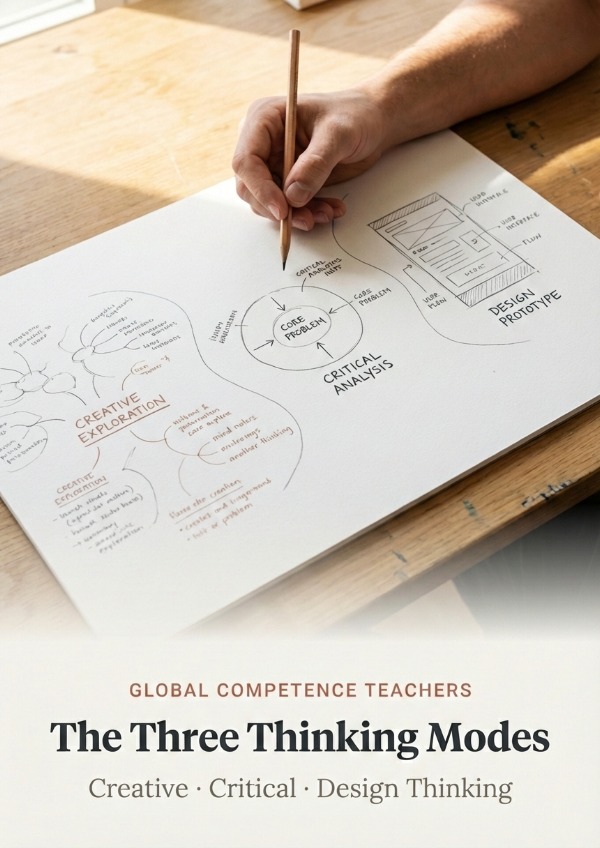
A teaching program that develops three distinct but complementary thinking modes — creative thinking (generating possibilities), critical thinking (evaluating claims and arguments), and design thinking (solving problems for people). Students learn to recognise which mode a situation demands and switch between them fluently.
An educator-led course, supported by structured reading and the LearningFirst learning platform.
About the program
This course covers five modules on the three thinking modes that together form a complete cognitive toolkit. Educators guide students through the foundations and practice of creative thinking (divergent ideation, lateral thinking, overcoming fixedness), critical thinking (logic, evidence evaluation, argument analysis, fallacy detection), and design thinking (empathy, prototyping, iteration, user-centred problem solving). The course emphasises metacognition — knowing which thinking mode to deploy and when to switch. Each session combines guided reading with structured thinking exercises, group problem-solving, and reflective analysis.
Curriculum & takeaways
Built on the core textbook The Three Thinking Modes — Creative, Critical, Design
What learners take away
- 3thinking modes reconciled into a single wide → deep → real process
- 5stages of Design Thinking — Empathize, Define, Ideate, Prototype, Test
- 6Six Thinking Hats for separating creative from critical mode deliberately
- 4predictable failures of collapsing or skipping any stage
- 3reasons these classical disciplines matter more in the AI era, not less
Curriculum structure
5 modules · 9 key concepts01 Introduction: Why These Three Thinking Modes, Why Now
Why classical thinking disciplines matter more in the AI era, not less.
02 Creative Thinking: Go Wide
The horizontal stroke. Generating the possibility space before any judgment is made.
03 Critical Thinking: Go Deep
The vertical stroke. Evaluating, selecting, and strengthening the most promising idea.
04 Design Thinking: Go Real
The dotted extension. Taking the selected idea into iterative contact with real human reality.
05 The T-Method: Three Modes, One Complete Process
The reconciliation. How Creative, Critical, and Design Thinking form a single unified methodology for solving anything worth solving.
Core understanding
- Creative, Critical, and Design Thinking are not alternatives — they are sequential stages of one complete process. Go wide, then deep, then real. Most bad outcomes come not from weakness in any one mode but from collapsing or skipping the sequence.
- Creative Thinking goes wide. Its discipline is suspending judgment, generating quantity before quality, using constraints as fuel, and protecting divergent thought from premature evaluation. Imagination is a trainable skill, not a personality trait.
- Critical Thinking goes deep. Its discipline is questioning assumptions, evaluating evidence quality, recognizing cognitive biases and logical fallacies, and stress-testing your chosen direction before committing. Critical Thinking is not criticism — it is intellectual rigor with intellectual humility.
- Design Thinking goes real. Empathize, define, ideate, prototype, test. Its discipline is human-centered observation, valuing what people do over what they say, and treating failure as data in iteration. Prototyping is building to think, not thinking to build.
- The T-Method makes the three coherent. Creative widens the possibility space, Critical selects and strengthens, Design tests against real humans. Skipping stages produces predictable failures: endless ideation, narrow rigor on an unimaginative option set, or iteration on a poorly chosen problem.
- These three modes are exactly what AI most conspicuously lacks. Origination, critical evaluation of its own output, and real human empathy in iteration are the capacities that remain human. That is why these disciplines become more valuable in the AI era, not less.
Questions students will explore
- Why do most people treat Creative, Critical, and Design Thinking as separate skills — and what changes when you see them as one process?
- What actually goes wrong when you skip a thinking stage or collapse the sequence?
- How does Creative Thinking differ from just brainstorming — and what discipline does 'going wide' actually require?
- What makes Critical Thinking genuinely critical rather than just being skeptical?
- How do you sequence the three modes into a repeatable method for solving any problem worth solving?
Key concepts
- The T-Method
- Go Wide, Go Deep, Go Real
- Divergent vs. Convergent Thinking
- Mode Collapse
- Creative Thinking as Discipline
- Critical Thinking as Depth
- Design Thinking as Reality Contact
- Sequential Mode Integration
- Problem-Solution Fit
Course-specific outcomes
Students will be able to:
• Apply creative thinking techniques (brainstorming, lateral thinking, SCAMPER) to generate novel ideas
• Evaluate arguments and evidence using critical thinking frameworks
• Use design thinking methodology to solve human-centred problems
• Recognise which thinking mode a given situation demands
• Switch fluently between creative, critical, and design thinking
• Reflect on their own thinking processes and identify cognitive biases
Assessment & accreditation
LearningFirst connects course learning, assessments, results, and student records in one system. Where included, examination and accreditation services are supported by Extracurricular Activity Excellence International Pte. Ltd. (EAE), whose registered Singapore business activity is “Examination and accreditation agencies for education services” (SSIC 85502). Any award remains subject to the course’s stated requirements.
Demonstrate understanding
Students take LearningFirst’s course assessments to show what they have learned.
Earn a certificate
Students who meet the required standards receive a certificate identifying its awarding entity and assessment standards.
Record the achievement
A learning transcript documents assessment results as part of the student’s learning record.
Lasting value, beyond the course
Achievements students can carry forward
Certificates, earned credits, and learning transcripts become lasting assets in each student’s learning portfolio—evidence of knowledge, effort, and achievement they can build on and present throughout their lives.
- Further study
- Professional development
- Future careers