Econ Beyond 2026 Issue 4
Last revised 6/26/2026

Econ Beyond 2026 Issue 4

Secondary

How platforms monetize your focus — the attention economy meets the digital commons, AI copyright wars, and the nudges shaping your every click.

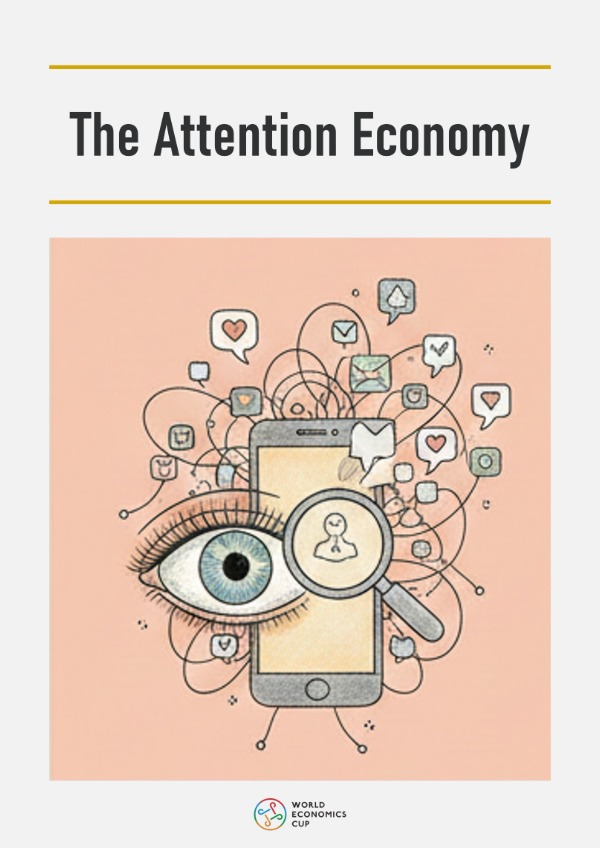
In this issue — The Attention Economy, we’ll explore how platforms like social media and streaming services monetize your focus as a scarce and valuable resource. We’ll analyze how advertisers and algorithms compete for your time, discussing articles like "Is Your Attention the Most Valuable Resource in the World — and Who's Profiting from It?" to uncover the hidden costs of "free" services. Get ready to rethink digital consumption through an economic lens!

Economics magazineApplied price theory
Earn5CreditsinEconomics
11Modules15Sessions139Cards34Quizzes

Modules in this Collection’s System

Hover a module to read it directly

Big Question

Is your attention the most valuable resource in the world? — Herbert Simon's 1971 prediction, the $500B industry built on it, and who profits from the externality on cognitive bandwidth.

1Session

Economist's Lens

Two micro-puzzles read through price theory — the digital tragedy of the commons (overgrazing → overposting), and the Card-Krueger minimum wage research that overturned a textbook consensus.

2Sessions

The Frontier

Two front-edge reports — the AI copyright wars (NYT v. OpenAI and the suits reshaping creative industries), and degrowth going mainstream as the EU questions GDP itself.

2Sessions

Everyday Life Economics

Two consumer-facing cases — why tipping in America has gotten out of control, and why bottled water exists as an industry that sells something that flows from the tap.

2Sessions

Economics Class

Two foundational principles — network economics and Metcalfe's Law (your network is your net worth), and advanced behavioral economics beyond Kahneman (Thaler, Sunstein, the nudge revolution).

2Sessions

Point vs. Counterpoint

Is globalization dead? — the post-2016 retreat from free-trade consensus, the case for 'slowbalisation,' and what the data on actual trade flows reveals.

1Session

Profile

Ha-Joon Chang, the heretic who challenged free-trade orthodoxy — *Bad Samaritans*, *Kicking Away the Ladder*, and the developmental-state critique of mainstream trade economics.

1Session

The Case

Sri Lanka's 2022 default — the anatomy of a sovereign debt crisis, what tax cuts and chemical-fertilizer bans did to the public finances, and IMF restructuring as the path back.

1Session

Lecture Hall

Michael Sandel, 'The Moral Foundations of Markets' — the Harvard Justice course that asks where markets should and shouldn't reach, and why moral philosophy matters to economics.

1Session

Read & Reflect

Daniel Kahneman, *Thinking, Fast and Slow* (2011) — the book that taught System 1 and System 2 to a popular audience, and consolidated decades of behavioral economics into one accessible volume.

1Session

Key Vocabulary

The issue's terminology card — attention economy, tragedy of the commons, monopsony, network effects, nudge, degrowth, fair use, and the rest of the working vocabulary for this issue.

1Session

What You'll Walk Away With

  • 1attention economy framework mapping how platforms convert user time into ad revenue, why infinite-scroll exists, and what the externality is on cognitive bandwidth and political discourse
  • 1digital commons diagnostic showing how unmoderated platforms decay through the same logic as overgrazed pastures — and what governance structures (Wikipedia, GitHub, Reddit) actually prevent it
  • 1AI copyright case briefing covering NYT v. OpenAI, the Getty/Stability AI suits, and the principles of fair use as they apply to training data
  • 1nudge design playbook distinguishing default settings, framing, social proof, and friction — with the ethical guardrails behavioral economists themselves draw
  • 1network economics card showing Metcalfe's Law, two-sided markets, and the lock-in mechanisms that make platform displacement so rare

You'll Have Answers To

  • ?Why is your attention now the most valuable resource in the world — and what's the externality on cognitive bandwidth?
  • ?Does the digital commons decay the same way physical commons do — and what governance structures actually prevent it?
  • ?Did the Card-Krueger minimum-wage study really overturn the textbook supply-demand consensus?
  • ?Who owns AI training data — and what will the NYT v. OpenAI suit decide about creative industries?
  • ?If GDP is the wrong scoreboard, what's the right one — and how serious is the degrowth movement?

Critical Concepts Explored

Attention economy and ad-funded business modelsTragedy of the commons (digital and physical)Card-Krueger minimum wage researchMonopsony in labor marketsAI copyright and fair useDegrowth and beyond-GDP indicatorsNetwork effects and Metcalfe's LawNudges and choice architecture (Thaler, Sunstein)Sovereign debt and default (Sri Lanka)Heterodox trade theory (Ha-Joon Chang)
Editor's Note
The most current issue of the series — and one of the sharpest

Issue 4 takes on the topics live economists are actually arguing about: attention markets, AI copyright, degrowth, and the Card-Krueger overturning of the minimum-wage consensus. The Ha-Joon Chang profile and Sri Lanka sovereign-debt case provide the international perspective; the bottled-water and tipping pieces make sure the consumer-economics throughline survives. Reads like *Foreign Policy* with the workings shown.

Editor's Brief
Who it's for
World Economics Cup and NEC competitors, AP/IB Economics students working on current-affairs questions, and any reader who wants to understand why their phone, their news feed, and their tipping habits are increasingly contested economic questions.
What stands out
The issue earns its currency — Card-Krueger as the labor-econ consensus rewrite, AI copyright as the live IP fight, degrowth as the live macro debate, tipping as the live consumer-policy issue. Each piece reports on something still unfolding.
Read if
You want one issue that ranges from the digital commons to sovereign debt to behavioral nudges — without ever sacrificing analytical rigor for breadth.
Gold Quotes
Herbert Simon predicted the attention economy in 1971: 'A wealth of information creates a poverty of attention.' Fifty years later, that poverty is the resource a $500 billion industry is built on.

Social media, streaming, and search platforms compete for time-on-screen because attention is the input that converts to ad revenue. The infinite scroll, the autoplay, the notification — these are engineering choices targeting the bottleneck Simon identified. The externality is on cognitive bandwidth, political discourse, and youth mental health; the regulatory question is whether market incentives can be redirected without breaking the platforms.

About the Curator
WWorld Economics Cup

Econ Beyond 2026 is World Economics Cup's flagship magazine series for LearningFirst — each issue takes one big question pulling at the global economy and works it through the discipline's full toolkit, from the Big Question essay down to the Key Vocabulary that lets readers explain it back. Built for learners preparing for the World Economics Cup, the National Economics Challenge, and any reader who wants their economic literacy current with the actual moment.