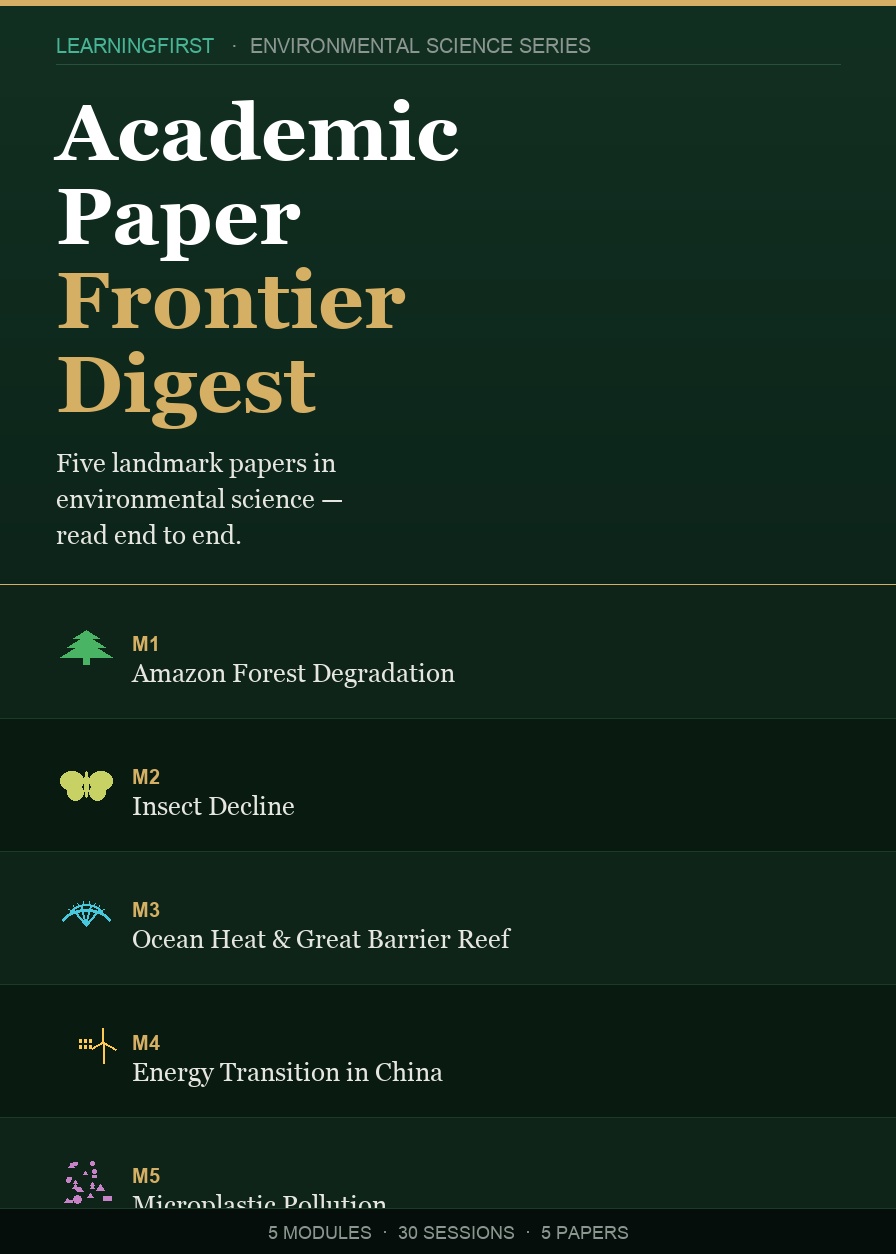
Academic Paper Frontier Digest
Last revised 7/8/2026

Academic Paper Frontier Digest

Five landmark environmental science papers, unpacked for competitive minds.

The Academic Paper Frontier Digest is a curated deep-dive into five landmark environmental science papers — each selected for its scientific rigour, real-world urgency, and direct relevance to the International Environmental Olympiad. Across five modules and thirty posts, readers move from the central question of each paper through its research design, key findings, mechanistic interpretation, limitations, and policy implications. Every post is written to build the analytical, evaluative, and evidence-based thinking that top-tier environmental competition tasks demand. This is not a summary collection — it is a structured thinking course built on primary environmental research.

5Modules30Sessions291Cards30Quizzes

Modules in this Collection’s System

Hover a module to read it directly

The Drivers and Impacts of Amazon Forest Degradation

A structured deep-dive into the paper: The Drivers and Impacts of Amazon Forest Degradation.

Subscription-free content inside
6Sessions

Disproportionate Declines of Formerly Abundant Insect Species

A structured deep-dive into the paper: Disproportionate Declines of Formerly Abundant Insect Species.

6Sessions

Highest Ocean Heat in Four Centuries Places Great Barrier Reef in Danger

A structured deep-dive into the paper: Highest Ocean Heat in Four Centuries Places Great Barrier Reef in Danger.

6Sessions

Accelerating the Energy Transition Towards Photovoltaic and Wind in China

A structured deep-dive into the paper: Accelerating the Energy Transition Towards Photovoltaic and Wind in China.

6Sessions

Twenty Years of Microplastic Pollution Research

A structured deep-dive into the paper: Twenty Years of Microplastic Pollution Research.

6Sessions

What You'll Walk Away With

  • 5paper deep-dives covering Amazon degradation, insect decline, coral reef warming, China's energy transition, and microplastic pollution
  • 30structured posts progressing from problem setup through study design, findings, mechanistic interpretation, critique, and policy application
  • 5critical analysis sections evaluating each paper's limitations and generalizability
  • 5policy application sections connecting each paper's findings to real conservation, energy, and regulatory decisions
  • 30quiz questions for testing comprehension and analytical reasoning across all five modules

You'll Have Answers To

  • ?If most Amazon forest is degraded rather than cleared, why does conservation policy focus almost exclusively on deforestation?
  • ?Why does losing abundant insect species matter more for ecosystems than losing rare ones?
  • ?How do scientists reconstruct 400 years of ocean temperature from coral skeletons — and what does that record reveal about today's GBR crisis?
  • ?Can China realistically meet its 2060 carbon neutrality target with solar and wind alone, and what is the single biggest obstacle?
  • ?If microplastics are now everywhere — including human blood and breast milk — why is the science of their harm still so contested?

Critical Concepts Explored

Forest degradation vs. deforestationEdge effects and fragmentationSpecies abundance distributionCoral bleaching and degree heating weeksProxy reconstruction and signal-to-noise ratioTime of emergenceLearning curves and levelised cost of energyUltra-high voltage transmissionPrimary vs. secondary microplasticsPrecautionary principle
Editor's Note
Five papers. Five crises. Thirty posts. One coherent way of thinking about environmental science.

The IEnvO APFD covers the most consequential environmental challenges of this century — forest loss, biodiversity collapse, ocean warming, the energy transition, and plastic pollution — through primary research rather than textbook distillation. Each module teaches you to read a real paper end-to-end: not just its conclusions, but its logic, its measurement choices, its assumptions, and where it falls short. By the third module, you will have internalised a framework for evaluating any environmental science paper — which is exactly the skill that Olympiad tasks test. Work through this collection seriously, and you will not just know these five papers. You will know how to think with environmental evidence.

Editor's Brief
Who it's for
Secondary school and university students preparing for the International Environmental Olympiad, or any motivated learner who wants to engage seriously with primary environmental science research.
What stands out
Each module teaches you to read a full paper end-to-end — not just its findings, but its logic, its data sources, its limitations, and its policy implications — using the same evaluative framework that Olympiad tasks reward.
Read if
You want to move beyond textbook summaries and develop the ability to think critically with real environmental research.
Gold Quotes
Degradation — not deforestation — is the dominant form of Amazon forest loss, affecting 38% of remaining forest between 2001 and 2018.

Lapola et al. (2023) synthesised remote-sensing data across fire, logging, edge effects, and drought to show that degraded area exceeded deforested area by a factor greater than one — reframing the Amazon crisis as an interior, distributed problem, not just a frontier one.