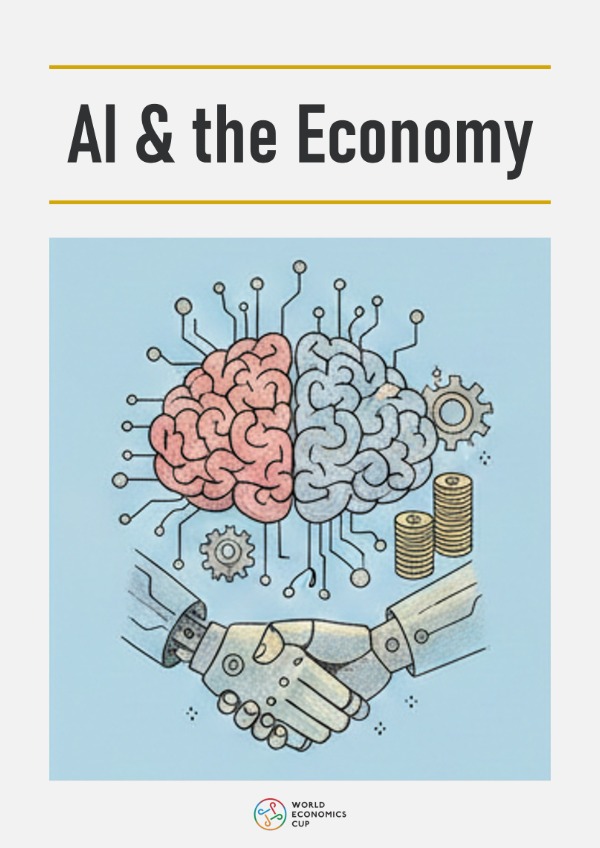
Econ Beyond 2026 Issue 1
Last revised 6/26/2026

Econ Beyond 2026 Issue 1

Secondary

How AI is reshaping markets, labor, and global competition — read through the full economics toolkit, from marginal thinking to sovereign-AI strategy.

In this issue — AI & the Economy, we’ll explore how artificial intelligence is reshaping markets, labor, and global competition, diving into provocative questions like whether AI-driven prosperity could trigger crises and why nations are racing to build sovereign AI systems. Alongside AI’s macroeconomic impact, we’ll unpack microeconomic puzzles—from dynamic pricing in supermarkets to the hidden costs of convenience—revealing how economists analyze these trends at the margin. Join us for a thought-provoking blend of cutting-edge tech and timeless economic principles!

Economics magazineApplied price theory
Earn5CreditsinEconomics
11Modules15Sessions160Cards38Quizzes

Modules in this Collection’s System

Hover a module to read it directly

Big Question

Will AI prosperity trigger an economic crisis? — the issue's hero question, the historical pattern of transformative-technology transitions, and the case for measured optimism over either utopia or panic.

1Session

Economist's Lens

Two micro-puzzles read through price theory — why your landlord keeps raising rent (housing as a supply-constrained market), and how a supermarket prices 40,000 products without a central planner.

2Sessions

The Frontier

Two front-edge reports — the Citrini Research note on the 2028 Global Intelligence Crisis that moved markets, and the global sovereign-AI race quietly being run by 50+ countries.

2Sessions

Everyday Life Economics

Two consumer-facing cases — why convenience charges (the airport bottle of water) extract premium prices from time-pressured buyers, and why every free trial is also a behavioral-economics experiment.

2Sessions

Economics Class

Two foundational principles taught for keeps — marginal thinking as the discipline's most underrated decision rule, and the principal-agent problem as the lens on every employment relationship.

2Sessions

Point vs. Counterpoint

Should central banks be independent? — the case for keeping monetary policy out of electoral politics, the case for democratic accountability, and what the IMF and emerging markets actually do.

1Session

Profile

Milton Friedman, the economist who remade the world — monetarism, Chicago-school free-market philosophy, and how a 5'3" debater shaped half a century of policy.

1Session

The Case

The Flint water crisis — what happens when cost-cutting ignores the social and health externalities imposed on residents, and the textbook diagnosis of government failure compounded by negative externalities.

1Session

Lecture Hall

Ray Dalio's 'How the Economic Machine Works' — 31 minutes that compress the credit cycle, productivity growth, and debt deleveraging into the most-cited public-economics video on YouTube.

1Session

Read & Reflect

Recommended reading list for this issue — the Citrini Research note that moved markets, plus deeper material on AI policy and macroeconomic transition risk.

1Session

Key Vocabulary

The issue's terminology card — creative destruction, marginal benefit/cost, principal-agent, externality, sovereign AI, monetarism, and the rest of the working vocabulary needed to talk about this issue's themes.

1Session

What You'll Walk Away With

  • 1AI-economy briefing covering the productivity shock, sovereign AI race, labor-market disruption, and the historical pattern of transformative-technology transitions
  • 1marginal thinking workbook for reframing hiring, pricing, study-time, and policy decisions as the economics-class question they actually are
  • 1principal-agent diagnostic showing how to spot misaligned incentives in employment, corporate governance, and politics — and what mechanisms restore alignment
  • 1price discovery field guide mapping how supermarkets, airports, and streaming services use convenience, captive markets, and free trials to set prices that maximize capture
  • 1Friedman cheat sheet distilling monetarism, central bank independence, and the policy positions that made him 20th-century economics' most influential public voice

You'll Have Answers To

  • ?Could AI-driven productivity gains paradoxically trigger a financial or labor-market crisis on the way to broad prosperity?
  • ?Why are 50+ countries spending billions to build sovereign AI capacity instead of just licensing American or Chinese models?
  • ?How does a supermarket price 40,000 individual products without a central planner — and what does that reveal about decentralized coordination?
  • ?Why is 'thinking at the margin' the most underrated idea in economics, and what does it actually let you do?
  • ?When is a free trial generosity, and when is it a behavioral pricing strategy designed to exploit the endowment effect?

Critical Concepts Explored

Productivity shock and the Solow paradoxSovereign AI and strategic technology infrastructureMarginal thinking and decision rulesPrincipal-agent problem and incentive alignmentConvenience pricing and captive marketsPrice discovery in decentralized marketsNegative externalities and government failureCentral bank independence and monetary credibilityCreative destruction (Schumpeter)Endowment effect and free-trial economics
Editor's Note
A magazine that earns its 'beyond 2026' framing

Issue 1 of Econ Beyond 2026 lands the format the series promises — Big Question opener on AI's economic shock, Economist's Lens micro-cases, Frontier reporting on sovereign AI, Profile of Friedman, plus the Flint case study and Friedman/Dalio reading lists. Reads like *The Economist* with the workings shown — current enough to be useful, rigorous enough to teach.

Editor's Brief
Who it's for
Students preparing for the World Economics Cup or National Economics Challenge, AP/IB Economics students looking for current applied material, and adult readers who want one source that connects AI's macroeconomic story to the price-theory tools that explain it.
What stands out
The 11-section magazine format — Big Question, Economist's Lens, The Frontier, Everyday Life Economics, Economics Class, Point vs. Counterpoint, Profile, The Case, Lecture Hall, Read & Reflect, Key Vocabulary — is the issue's pedagogical spine, not decoration; readers move from stakes to mechanism to history to vocabulary in one sitting.
Read if
You want one substantial monthly read that catches you up on a major economic question and walks you through the toolkit needed to think about it — not a news digest, not a textbook chapter.
Gold Quotes
Every transformative technology arrives with a paradox: it promises to lift everything, and then it takes longer than promised, with more disruption than promised, before the gains arrive — and they arrive unevenly even then. AI is unlikely to break the pattern.

Steam took 100 years to fully restructure the British economy. Electricity took 40 years to show up in productivity statistics — the famous Solow paradox. The internet's productivity bump was muted for two decades after commercial deployment. The current question isn't whether AI is transformative but whether the transition produces its own crisis — labor displacement, financial bubbles, geopolitical fracture — before the prosperity story plays out.
About the Curator
WWorld Economics Cup

Econ Beyond 2026 is World Economics Cup's flagship magazine series for LearningFirst — each issue takes one big question pulling at the global economy and works it through the discipline's full toolkit, from the Big Question essay down to the Key Vocabulary that lets readers explain it back. Built for learners preparing for the World Economics Cup, the National Economics Challenge, and any reader who wants their economic literacy current with the actual moment.