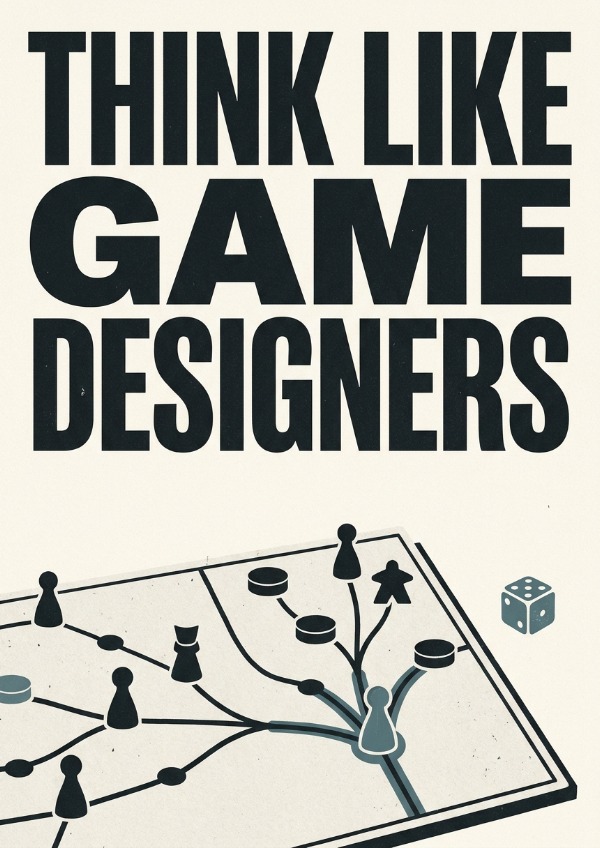
Think Like Game Designers
Last revised 7/31/2026

Think Like Game Designers

Professional

The mental models that power voluntary engagement — and work everywhere.

Game designers are among the most rigorous applied behaviorists alive: they build systems where every participant is a volunteer, free to leave at any moment with zero penalty. That constraint has produced forty years of precise thinking about feedback loops, meaningful choice, flow calibration, emergent behavior, and iterative testing — and every one of those frameworks transfers. This collection extracts the thinking tools forged in game design and hands them to professionals who design products, teams, organizations, and strategies. These are not lessons about how to make games. They are lessons about the architecture of voluntary engagement, applied to every system where people are free to leave.

ParadigmToolkit
Earn4CreditsinDesignProduct DevelopmentScientific Thinking
6Modules30Sessions270Cards60Quizzes

Modules in this Collection’s System

Hover a module to read it directly

The Designer's Worldview

The foundational lenses game designers use to see systems, constraints, and human behavior — before they design anything.

5Sessions

The Architecture of Choice

How game designers engineer decisions that feel meaningful — and what kills a choice before it's made.

5Sessions

Feedback and Flow

How the loops between action and response create engagement, learning, and — when poorly designed — addiction.

5Sessions

Systems and Emergence

Why simple rules produce complex behavior, how economies break, and what it means to design for outcomes you can't predict.

5Sessions

The Craft of Experience

The harder-to-name qualities that separate functional systems from ones people love — teaching, pacing, failure, and feel.

5Sessions

The Design Process

How game designers actually work: testing, iterating, constraining, and shipping into uncertainty.

5Sessions

What You'll Walk Away With

  • 6mental models for designing systems people choose to enter and stay in
  • 4diagnostic frameworks for reading feedback loops, flow states, and emergent behavior before they spiral
  • 3decision-design tests that distinguish choices that matter from choices that merely feel like they do
  • 5process disciplines from iterative game design — playtesting, constraint-setting, iteration, and shipping into uncertainty
  • 2ethical frameworks for navigating the line between engagement design and compulsion design

You'll Have Answers To

  • ?What makes a choice actually matter — and why do most real-world decisions fail the test?
  • ?How do game designers keep people in the flow channel when skill and difficulty are constantly changing?
  • ?Why do simple rules produce complex behavior, and how do you design for outcomes you can't predict?
  • ?What separates onboarding that genuinely teaches from onboarding that makes people feel taught?
  • ?When should a designer listen to users — and when is listening the wrong move?

Critical Concepts Explored

Magic CircleMeaningful ChoiceFeedback LoopFlow ChannelDominant StrategyPossibility SpaceEmergent GameplayRubber BandingOrthogonal DifferentiationCompulsion Loop
Editor's Note
The most rigorous thinking on voluntary engagement, extracted and handed over.

Game designers build systems no one has to use. That constraint produces some of the most precise applied thinking about incentives, feedback, and human behavior available in any discipline. This collection translates that thinking into frameworks any system designer can deploy — without touching a game engine.

Editor's Brief
Who it's for
Product builders, strategists, managers, and educators who design systems other people use and want rigorous mental models for making those systems compelling.
What stands out
This collection translates game design's intellectual core — forged under the uniquely demanding constraint of voluntary participation — into frameworks for incentive design, choice architecture, and iterative testing that require no gaming background to apply.
Read if
Read if you design systems — products, teams, curricula, processes, organizations — and want to understand why some systems produce engagement and learning while others produce compliance and boredom.
Gold Quotes
The player can quit at any moment. That single constraint forces every design decision to earn its place.

Game designers work without the safety net most system-builders take for granted: their audience is entirely voluntary. Nothing is held in place by obligation, authority, or switching cost. That constraint has produced forty years of rigorous thinking about engagement, and the thinking transfers to every system where people are free to leave.

About the Curator
TThink Like Great Minds

Think Like Great Minds is a LearningFirst series that extracts the thinking tools of history's sharpest practitioners — game designers, mathematicians, AI researchers — and hands them to professionals who design systems other people use. Every collection translates a discipline's intellectual core into transferable mental models, not discipline-specific skills.