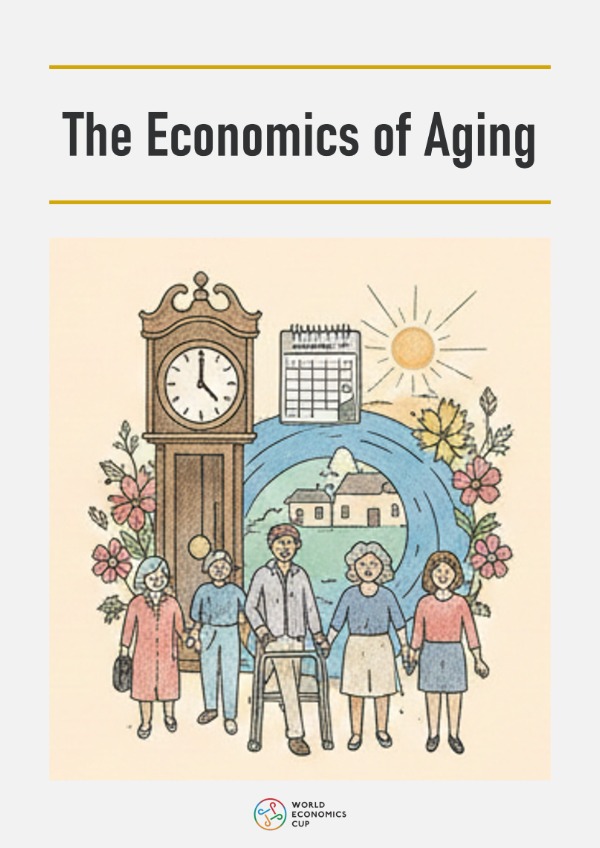
Econ Beyond 2026 Issue 6
Last revised 6/26/2026

Econ Beyond 2026 Issue 6

Secondary

What happens when there aren't enough young people? — read through the diamond-water paradox, institutional economics, the Coase theorem, and the case for taxing robots.

In this issue — The Economics of Aging, we’ll explore how shifting demographics impact economies—from labor shortages to pension crises—and challenge traditional ideas of value and sustainability. Through real-world case studies like India’s population boom and the eerie foresight of insurance companies, we’ll debate whether aging societies fuel policy shifts like industrial subsidies or speculative markets like carbon credits. Along the way, we’ll uncover hidden pricing strategies—from $8 popcorn to smartphone plans—revealing how captive markets exploit predictability in an uncertain world.

Economics magazineApplied price theory
Earn5CreditsinEconomics
11Modules16Sessions169Cards41Quizzes

Modules in this Collection’s System

Hover a module to read it directly

Big Question

What happens to an economy when there aren't enough young people? — South Korea's 0.72 fertility rate, Japan's 30-year head start, and the slowest-moving crisis of the 21st century.

1Session

Economist's Lens

Two micro-puzzles read through price theory — the diamond-water paradox dissolved by marginal analysis, and asymmetric information as the substrate of the modern insurance industry.

2Sessions

The Frontier

Three front-edge stories — India overtaking China as the world's largest population, the return of industrial policy (CHIPS Act, IRA, Made in 2025), and the carbon-credits-don't-work investigation.

3Sessions

Everyday Life Economics

Two consumer-facing cases — why movie popcorn costs $8 (the captive-market mechanic at work), and the hidden economics of your smartphone plan.

2Sessions

Economics Class

Two foundational principles — institutional economics (Acemoglu & Robinson on why nations fail), and the Coase theorem on how property rights resolve externalities.

2Sessions

Point vs. Counterpoint

Should we tax robots? — the Bill Gates proposal, the case for and against, and what the policy debate reveals about how economists think about labor displacement.

1Session

Profile

Esther Duflo, the experimentalist who changed how we fight poverty — the youngest economics Nobel laureate, J-PAL, and the randomized-controlled-trial revolution in development economics.

1Session

The Case

Foxconn's empty Wisconsin factories — the textbook case study in industrial policy gone wrong, and what subsidy-driven development promises that it consistently fails to deliver.

1Session

Lecture Hall

Richard Wilkinson, 'How Economic Inequality Harms Societies' (TED, 2011) — the talk that made *The Spirit Level* a phenomenon and put inequality back on the public-economics agenda.

1Session

Read & Reflect

Acemoglu and Robinson, *Why Nations Fail* (2012) — the most ambitious work of political economy of the 21st century, and the institutional argument that won its authors the 2024 Nobel.

1Session

Key Vocabulary

The issue's terminology card — dependency ratio, diamond-water paradox, asymmetric information, industrial policy, carbon credits, Coase theorem, and the rest of the working vocabulary for this issue.

1Session

What You'll Walk Away With

  • 1demographic transition map showing the trajectory from high-fertility-high-mortality through aging-society to demographic decline — and the labor-force, pension, and consumer-market implications at each stage
  • 1institutional economics framework distinguishing extractive vs. inclusive institutions (Acemoglu & Robinson), with the comparative cases (Korea/Korea, US/Mexico borders) that make the argument concrete
  • 1Coase theorem decision tree for when property-rights bargaining solves externalities efficiently, and when transaction costs make government intervention preferable
  • 1carbon credit due-diligence card for spotting which credits represent genuine additional savings vs. accounting fictions — the structural problem and the proposed fixes
  • 1industrial policy scorecard comparing CHIPS Act, IRA, Made in China 2025, and the EU Green Deal — with the conditions under which strategic subsidies historically have or haven't worked

You'll Have Answers To

  • ?What happens to an economy when there aren't enough young people — and why is the political response so consistently denial?
  • ?Why does the diamond-water paradox dissolve once you understand marginal analysis — and what does that reveal about value generally?
  • ?Why does your insurance company know more about you than you do — and what happens when they don't?
  • ?Should governments tax robots — and what does Bill Gates's proposal reveal about how we think about labor displacement?
  • ?When does Coase's theorem tell us markets can solve externalities themselves, and when does it tell us we need government?

Critical Concepts Explored

Dependency ratio and demographic transitionDiamond-water paradox and marginal utilityAsymmetric information in insuranceDemographic dividend (and its end)Industrial policy and strategic subsidiesCarbon credits and externality pricingCaptive markets and pricing powerInstitutional economics (Acemoglu & Robinson)Coase theorem and property rightsRobot tax and automation policy
Editor's Note
A serious treatment of demographics — finally not a panic piece

Issue 6 takes on aging societies with the rigor the topic deserves and the realism the genre usually lacks — pension math, immigration trade-offs, productivity-and-AI substitution, and the Esther Duflo profile of experimentalist development economics. The Coase-theorem and institutional-economics pieces give the issue real theoretical spine; the popcorn captive-market piece reminds you the magazine never loses sight of the consumer.

Editor's Brief
Who it's for
World Economics Cup and NEC competitors, AP/IB Economics students working on demographics or development questions, and any reader who wants serious tools for thinking about the slowest-moving, most-consequential macro story of the next 50 years.
What stands out
The issue refuses to treat aging as a panic — it walks through the actual mechanisms (labor force, pension funding, consumer demand shifts, capital substitution), pairs them with the Coase-theorem and institutional-economics tools that explain policy responses, and ends with a concrete failed case (Foxconn-Wisconsin) for industrial policy.
Read if
You want one substantial read on the demographic story that's quietly rewriting the next century — with the institutional-economics and Coasean tools needed to think about it clearly.
Gold Quotes
Demographic decline is the slowest, most-foreseeable crisis the modern world has ever watched coming — and the political response in most affected countries is still mostly denial.

South Korea's 0.72 fertility rate is the lowest ever recorded for a major economy. Japan has been in demographic decline since 1995 and is now the world's working laboratory for what aging societies look like. Italy's pension obligations are mathematically unsustainable on current contribution trajectories. The eventual reckonings — immigration policy, retirement age, intergenerational transfer — are all visible decades out, and democracies seem structurally bad at addressing them.

About the Curator
WWorld Economics Cup

Econ Beyond 2026 is World Economics Cup's flagship magazine series for LearningFirst — each issue takes one big question pulling at the global economy and works it through the discipline's full toolkit, from the Big Question essay down to the Key Vocabulary that lets readers explain it back. Built for learners preparing for the World Economics Cup, the National Economics Challenge, and any reader who wants their economic literacy current with the actual moment.