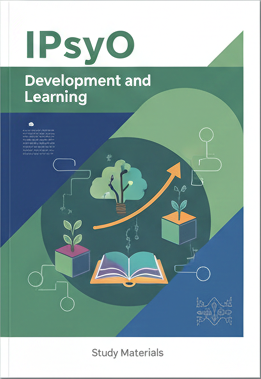
Development and Learning
Last revised 6/18/2026

Development and Learning

Secondary

How a helpless infant becomes a reasoning adult — the stages, the mechanisms, and the debates that shape every life span.

This collection covers life span development (Piaget, Erikson, Kohlberg), developmental stages from prenatal to adulthood, genetic and environmental influences, classical and operant conditioning, observational learning, and language development and communication. Aligned with the IPsyO (International Psychology Olympiad) syllabus.

Academic primerDevelopmental psychology
Earn3CreditsinPsychology
3Modules9Sessions141Cards43Quizzes

Modules in this Collection’s System

Hover a module to read it directly

1. Life Span Development

Stage theories and lifespan development — how Piaget, Erikson, and Kohlberg each describe the reorganizations that mark growing up.

Subscription-free content inside
3Sessions

2. Learning

The three mechanisms of learning — classical conditioning, operant conditioning, and observational learning as separable processes with distinct signatures.

Subscription-free content inside
3Sessions

3. Language

Language as a development puzzle — from babbling to grammar, and the nativist/behaviorist debate about what makes it possible.

3Sessions

What You'll Walk Away With

  • 1stage theory comparison chart laying Piaget's cognitive stages, Erikson's psychosocial crises, and Kohlberg's moral reasoning levels side-by-side so the ages and transitions line up
  • 1classical vs. operant conditioning decision tree distinguishing UCS/UCR/CS/CR associations from reinforcement/punishment contingencies so students pick the right mechanism fast
  • 1reinforcement schedule card showing continuous, fixed-ratio, variable-ratio, fixed-interval, and variable-interval schedules with their signature response patterns
  • 1language milestones timeline mapping cooing, babbling, one-word, two-word, and telegraphic speech to typical ages with the theoretical accounts that explain each
  • 1nature/nurture integration map showing how twin studies, heritability estimates, and gene-environment interaction research actually decompose a trait

You'll Have Answers To

  • ?What do Piaget, Erikson, and Kohlberg each capture about human development that the others miss?
  • ?Why does 'nature vs. nurture' keep being the wrong question — and what's the right decomposition?
  • ?What distinguishes classical conditioning from operant conditioning, and why does mixing them always lead to wrong predictions?
  • ?Why does variable-ratio reinforcement produce such stubbornly persistent behavior — and what does that explain about gambling and social media?
  • ?Can a behaviorist like Skinner account for how a child acquires grammar, or does language acquisition force a nativist position?

Critical Concepts Explored

Piaget's sensorimotor, preoperational, concrete-operational, formal-operational stagesErikson's psychosocial crises across the lifespanKohlberg's preconventional / conventional / postconventional moral reasoningTeratogens and prenatal developmentNature-nurture interaction and epigeneticsClassical conditioning (UCS, UCR, CS, CR)Operant conditioning and reinforcement schedulesObservational learning and modeling (Bandura)Language acquisition: LAD vs. reinforcement accountsCritical and sensitive periods
Editor's Note
Development and learning as one coherent story

The collection's move of pairing stage theories (Piaget, Erikson, Kohlberg) with learning mechanisms (Pavlov, Skinner, Bandura) pays off: readers see development not as biological ticking-clock nor as pure environmental shaping, but as the outcome of both running together. The language-acquisition debate is particularly well handled — neither behaviorism nor nativism gets a free pass.

Editor's Brief
Who it's for
Students preparing for IPsyO, AP Psychology, or any introductory developmental-psychology course that expects you to apply stage theories to cases rather than just name the stages.
What stands out
Stage theories and learning mechanisms are taught together, so readers finish able to explain why a child behaves a particular way at a particular age — from both a cognitive-stage angle and a reinforcement-history angle.
Read if
You want to leave with a working model of how a person develops — not a pile of names, dates, and stages with no through-line.
Gold Quotes
Classical conditioning is about what predicts what. Operant conditioning is about what produces what. Almost every 'learning unit' error on an exam comes from blurring these two distinct mechanisms.

Pavlov's dog salivates to a bell because the bell reliably preceded food — the learning is an association between two stimuli, independent of the dog's behavior. Skinner's rat presses a lever because pressing produced food — the learning is a contingency between a behavior and its consequence. Both are real; both are distinct; mixing them leads directly to wrong predictions.
About the Curator
IInternational Psychology Olympiad

International Psychology Olympiad is the editorial voice behind LearningFirst's IPsyO-aligned collections — producing rigorous, exam-ready primers on core psychological science for learners preparing for competitions and introductory university coursework.