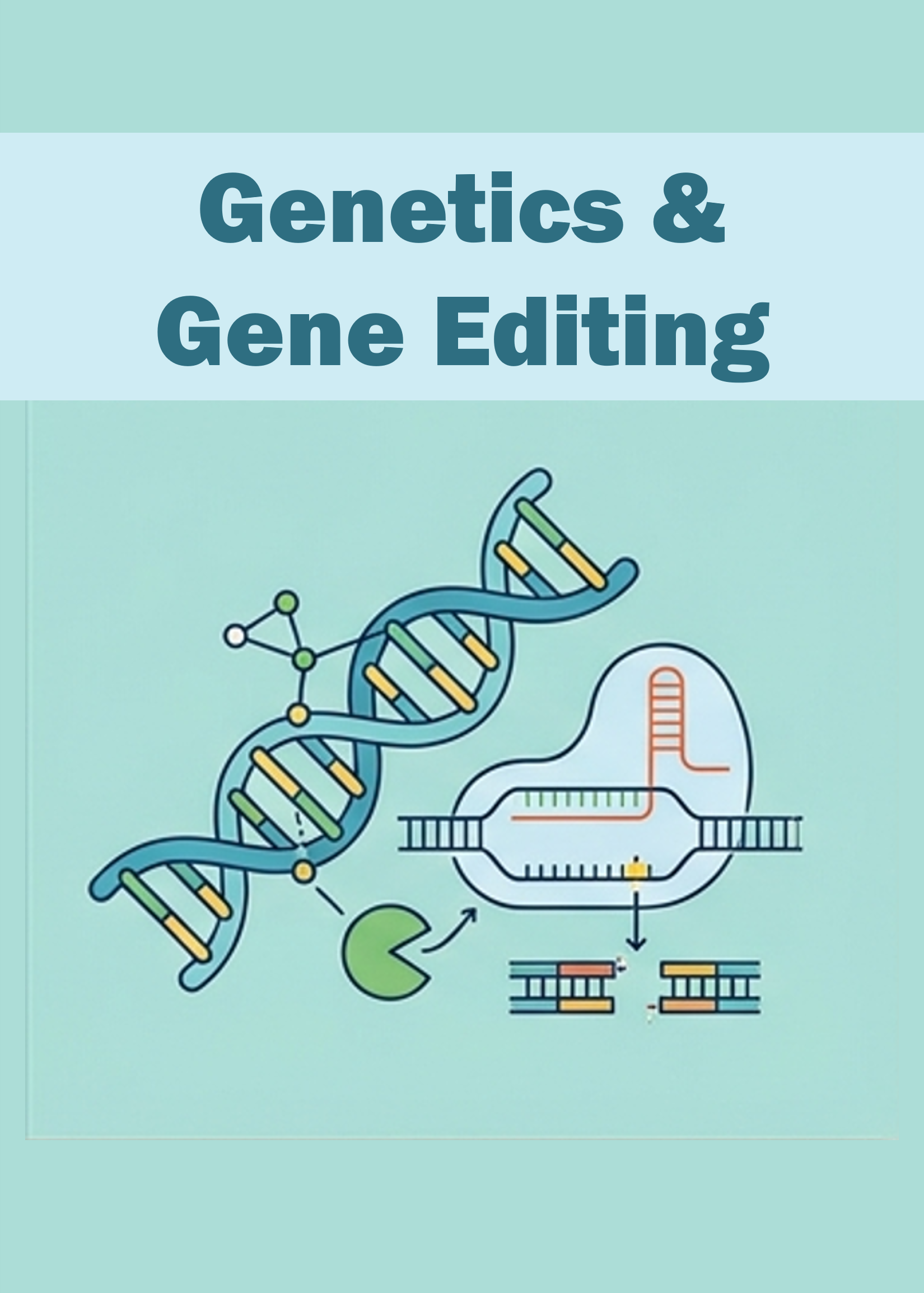
Biothon - Genetics & Gene Editing
Last revised 5/21/2026

Biothon - Genetics & Gene Editing

Secondary

Molecular genetics, classical and population genetics, gene regulation, CRISPR, genomics, gene therapy, and agricultural biotech — taught at Biothon competition rigor.

A comprehensive study collection for the Biothon biology competition covering genetics and gene editing. Topics span molecular genetics foundations (DNA structure, replication, gene expression), classical and population genetics (Mendelian inheritance, Hardy-Weinberg, chromosomal mutations), gene regulation and epigenetics (transcription factors, chromatin remodeling, DNA methylation, non-coding RNA), CRISPR and gene editing technologies (Cas9, base editing, prime editing, delivery methods), genomics and bioinformatics (sequencing technologies, genome analysis, computational tools), gene therapy and clinical applications (viral/non-viral vectors, ex vivo/in vivo therapies, ethical implications), and genetic engineering in agriculture and industry (GMOs, synthetic biology, forensic genetics). Designed for advanced high school students with emphasis on molecular mechanisms, cutting-edge technologies, and real-world applications.

Academic primerBiology olympiad prep
Earn3CreditsinBiology
7Modules23Sessions235Cards75Quizzes

Modules in this Collection’s System

Hover a module to read it directly

Molecular Genetics Foundations

DNA structure, replication, transcription, translation — the central dogma and its working biochemistry.

Subscription-free content inside
3Sessions

Classical and Population Genetics

Mendelian inheritance, complex traits, Hardy-Weinberg equilibrium, and the population genetics that quantify evolution.

3Sessions

Gene Regulation and Epigenetics

Transcription factors, chromatin modification, microRNAs, and epigenetics — the regulatory layers above DNA sequence.

4Sessions

CRISPR and Gene Editing Technologies

CRISPR-Cas9, base editors, prime editors, and the genome-editing toolkit reshaping research and medicine.

4Sessions

Genomics and Bioinformatics

Whole-genome sequencing, GWAS, single-cell methods, and the bioinformatics making genomic-scale biology routine.

3Sessions

Gene Therapy and Clinical Applications

AAV vectors, CAR-T, ex-vivo and in-vivo gene therapy — clinical gene editing from concept to approved therapy.

3Sessions

Genetic Engineering in Agriculture and Industry

GMOs, gene-edited crops, industrial biotech, and the regulatory and ethical frameworks shaping deployment.

3Sessions

What You'll Walk Away With

  • 1central dogma reference with replication, transcription, translation, and the regulatory and modification layers that complicate the simple textbook story
  • 1classical genetics troubleshooter distinguishing Mendelian, codominant, polygenic, X-linked, and epistatic inheritance with the testcross math for each
  • 1Hardy-Weinberg + population genetics card with allele frequency math, the assumptions, and how violations (selection, drift, migration, mutation, non-random mating) reshape populations
  • 1CRISPR toolkit comparing Cas9, base editors, prime editors, and the off-target / delivery considerations that determine clinical applicability
  • 1gene therapy decision tree matching disease type (recessive deficiency, dominant gain-of-function, complex polygenic) to vector strategy (AAV, lentivirus, ex-vivo, in-vivo)

You'll Have Answers To

  • ?Why was CRISPR-Cas9 such a paradigm shift in genome editing — and what do base editors and prime editors add?
  • ?What does Hardy-Weinberg equilibrium predict, and why is every deviation diagnostically useful?
  • ?How does gene regulation produce 200+ cell types from one genome — and what does single-cell sequencing reveal that bulk methods missed?
  • ?Why do most genetic traits not follow simple Mendelian inheritance — and what frameworks (epistasis, polygenic, GWAS) handle the complexity?
  • ?Which gene therapy strategies (AAV, CAR-T, in-vivo CRISPR) match which disease types, and what determines clinical viability?

Critical Concepts Explored

DNA structure and semiconservative replicationCentral dogma and post-transcriptional modificationsMendelian, codominant, polygenic, and epistatic inheritanceHardy-Weinberg equilibrium and population geneticsTranscription factors and chromatin modificationMicroRNAs and epigenetic regulationCRISPR-Cas9, base editors, prime editorsWhole-genome sequencing and GWASAAV vectors and gene therapyGMOs and agricultural biotech
Editor's Note
Genetics from base pairs to base editors, taught coherently

This collection covers an ambitious arc — molecular structure, classical and population genetics, gene regulation, CRISPR, genomics, clinical gene therapy, agricultural biotech — without losing the through-line. The CRISPR sections distinguish Cas9 from base editors and prime editors with the precision a competitor needs; the gene therapy sections handle AAV, CAR-T, and in-vivo editing with clinical realism.

Editor's Brief
Who it's for
Biothon and IBO competitors preparing for genetics and biotechnology rounds, AP/IB Biology students needing depth on molecular and population genetics, and pre-medical students who want gene therapy and CRISPR treated rigorously.
What stands out
The collection refuses to teach 'classical' and 'molecular' genetics as separate domains — Mendelian inheritance, population genetics, gene regulation, and modern editing technologies all share one continuous treatment.
Read if
You want to understand CRISPR, base editing, gene therapy, and GWAS at the level of the underlying biology — not just the news headlines.
Gold Quotes
CRISPR-Cas9 democratized genome editing because it's programmable. Earlier targeted-editing systems (zinc-finger nucleases, TALENs) required a custom protein for each target site; CRISPR just needs a 20-nucleotide guide RNA.

Doudna and Charpentier won the 2020 Nobel for the 2012 paper showing this works in cell-free systems. Within a decade, CRISPR became standard in molecular biology labs, was approved for sickle cell disease (Casgevy, 2023), and progressed to clinical trials for dozens of conditions. Base editors and prime editors extend the precision; the off-target and delivery problems remain the engineering frontier.

About the Curator
AAcademic Marathon

Academic Marathon is the editorial voice behind LearningFirst's Physithon and Biothon competition-prep collections — producing rigorous, mathematically grounded primers across the cutting-edge sub-disciplines of physics and biology that competition-track high-school students need to know.

Biothon - Genetics & Gene Editing | LearningFirst