Academic Paper Frontier Digest
Last revised 7/18/2026

Academic Paper Frontier Digest

Secondary

International Finance Olympiad

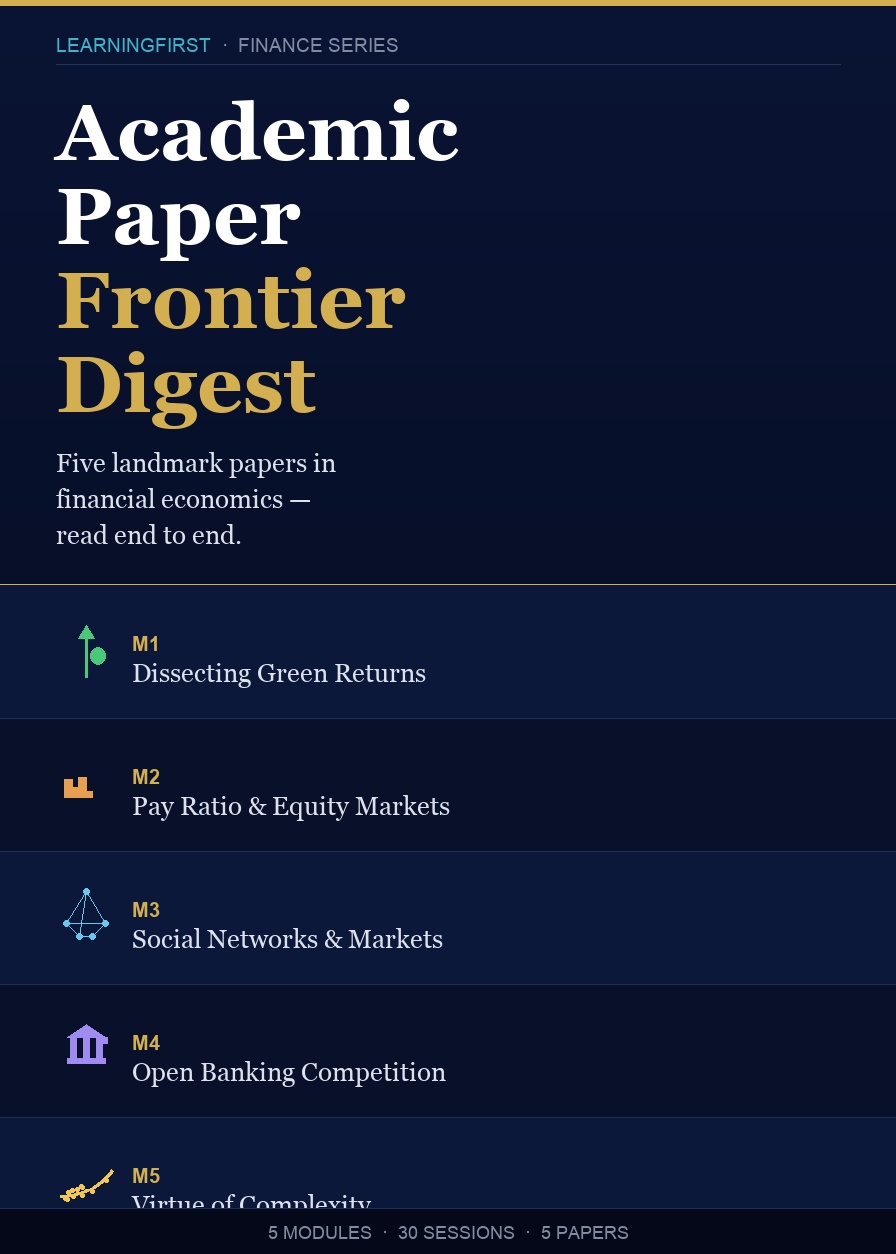
Five landmark papers in financial economics, broken into 30 guided reading sessions. Each session presents the research question, theoretical framework, key findings, and implications — building systematic academic reading skills one study at a time.

FinanceEconomicsAcademic ResearchESGFintechMachine Learning
5Modules30Sessions281Cards30Quizzes

Modules in this Collection’s System

Hover a module to read it directly

Dissecting Green Returns

Pastor, Stambaugh & Taylor · Journal of Finance 2022

6Sessions

Do Equity Markets Care About Income Inequality?

Pan, Pikulina, Siegel & Wang · Journal of Finance 2023

6Sessions

Game On: Social Networks and Markets

Pedersen · Journal of Financial Economics 2022

6Sessions

Open Banking: Credit Market Competition When Borrowers Own the Data

He, Huang & Zhou · Review of Financial Studies 2023

6Sessions

The Virtue of Complexity in Return Prediction

Kelly, Malamud & Zhou · Journal of Finance 2024

6Sessions

What You'll Walk Away With

  • 5paper deep-dives covering green asset pricing, pay ratio disclosure, social network models, open banking competition, and machine learning return prediction
  • 30structured posts progressing from problem motivation through theoretical framework, data design, core findings, mechanistic interpretation, and real-world implications
  • 5critical analysis sections evaluating each paper's assumptions, limitations, and generalizability to other markets and time periods
  • 5policy and practitioner sections connecting each paper's findings to ESG investing, regulatory design, market microstructure, and asset management practice
  • 30quiz questions testing conceptual understanding, logical reasoning, and the ability to distinguish correlation from causation in empirical finance
  • A transferable framework for reading academic finance papers: research question → identification strategy → key assumption → main finding → implication → limitation

You'll Have Answers To

  • ?If green stocks outperformed brown by 174 percentage points over 2012–2020, why should investors expect green assets to earn lower returns going forward?
  • ?How can equity markets be described as 'caring about' income inequality when prices are supposed to reflect only expected cash flows and discount rates?
  • ?What does it mean for a single influential investor in a social network to have 'market power' — and what does that imply for price efficiency?
  • ?Why does voluntary data sharing under open banking create an adverse selection problem, and why can that problem make every borrower worse off even when fintech lenders are more efficient?
  • ?If a return-prediction model has a negative out-of-sample R², how can it generate a statistically and economically significant Sharpe ratio?

Critical Concepts Explored

Expected vs. realized returnsGreenium and ESG pricingCounterfactual return decompositionInequality aversion and investor preferencesEvent study and cumulative abnormal returnsDeGroot social learning and belief dynamicsThought leadership and influencer market powerAdverse selection and the lemons problemOpen banking and data portabilityBias-variance tradeoff and the virtue of complexity
Editor's Note
Five papers. Five frontiers. Thirty posts. One framework for reading financial economics.

The IFO APFD covers five areas where financial economics has produced genuinely surprising results in the past five years: the return puzzle of green assets, the market pricing of social inequality, the mechanics of belief propagation through investor networks, the unintended consequences of open banking, and the statistical paradox of complexity in return prediction. Each module teaches you to read a real paper end-to-end — not just its conclusions, but its logic, its measurement choices, its assumptions, and its limits. The goal is not to memorize findings but to build the habit of asking: what is the question, why does it matter, what does the evidence actually show, and what remains uncertain? That habit is what separates good financial economists from good financial consumers.

Editor's Brief
Who it's for
Secondary school and university students preparing for the International Finance Olympiad, or any motivated learner who wants to engage seriously with primary research in financial economics.
What stands out
Each module teaches you to read a full paper end-to-end — not just its findings, but its question, its identification strategy, its assumptions, and its limits — using the same evaluative framework that Olympiad tasks reward. The five papers were selected to span ESG investing, behavioral finance, network economics, fintech market design, and machine learning in finance.
Read if
You want to move beyond textbook summaries and develop the ability to think critically with real financial economics research. This collection treats you as a future economist: it shows you how researchers frame questions, what assumptions they make, what they find, and what remains genuinely unresolved.
Gold Quotes
Green stocks earned 174 percentage points more than brown stocks over 2012–2020, but this outperformance reflected changing climate concerns — not higher expected returns.

Pastor, Stambaugh, and Taylor (2022) use German twin bonds and a counterfactual regression design to show that the same mechanism that generates realized green outperformance also implies lower expected returns for green assets held at today's prices.

About the Curator
IInternational Finance Olympiad

This collection was curated by the LearningFirst academic content team in partnership with the International Finance Olympiad. The five papers were selected for their rigor, originality, and relevance to the IFO's focus on contemporary financial economics — covering ESG, behavioral finance, network models, fintech regulation, and machine learning applications in markets.