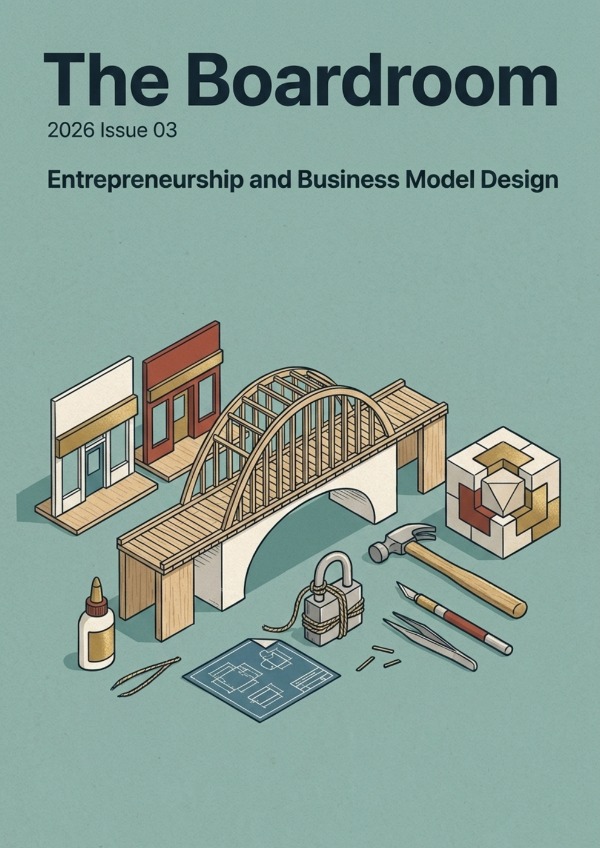
The Boardroom 2026 Issue 03 - Entrepreneurship and Business Model Design
Last revised 6/13/2026

The Boardroom 2026 Issue 03 - Entrepreneurship and Business Model Design

Secondary

Startup opportunity, model logic, financing, metrics, and scaling judgment

This International Business Olympiad "The Boardroom" issue trains students to evaluate opportunities, business models, startup financing, product-market fit, scaling, and strategic adaptation. It uses Airbnb, Canva, BYD, SaaS, cross-border e-commerce, EVs, marketplace liquidity, contribution margin, venture capital, subsidy design, hardware supply chains, and major acquisitions to build contest-ready entrepreneurial judgment. The collection treats a business model as a testable system of customer pain, channel access, revenue quality, cost structure, moat, and risk.

Startup LensCase Prep
Earn3CreditsinBusiness Acumen
7Modules21Sessions231Cards42Quizzes

Modules in this Collection’s System

Hover a module to read it directly

Company Case

Read entrepreneurial turning points through trust, distribution, supply, and capability creation.

3Sessions

Industry Briefing

Map market structure before judging whether a startup opportunity is attractive.

6Sessions

Business Model Lens

Use business model tools to test revenue, cost, moat, and incentive logic.

6Sessions

Operational Metrics Room

Interpret startup metrics as evidence about retention, liquidity, margin, and cash.

6Sessions

Founder/Operator Decision

Practice financing, subsidy, and supply-chain choices under real constraints.

6Sessions

M&A and Strategic Deals Analysis

Read acquisitions through strategic fit, distribution, competition, and integration risk.

6Sessions

Case Challenge

Build contest-ready startup recommendations from opportunity, GTM, and scaling exhibits.

6Sessions

What You'll Walk Away With

  • 7opportunity tests for judging pain, market size, channels, and unit economics
  • 12startup metric distinctions for ARR, retention, liquidity, margin, payback, and scaling
  • 6business model lenses for canvases, network effects, vertical integration, SaaS, marketplaces, and hardware
  • 5founder decision patterns for financing, subsidies, supply chains, GTM, and post-PMF scaling
  • 3deal-analysis frames for defensive acquisitions, platform supply, and strategic fit

You'll Have Answers To

  • ?How can students tell whether a startup idea is truly worth pursuing?
  • ?When does rapid growth make a business model stronger, and when does it hide weakness?
  • ?How should founders choose between venture capital, bootstrapping, subsidies, and supply-chain control?
  • ?What evidence proves a network effect, marketplace, or SaaS model is healthy?
  • ?Why do strategic acquisitions sometimes buy distribution, supply, and system fit rather than revenue alone?

Critical Concepts Explored

Customer Pain TestBusiness Model CanvasNetwork EffectsVertical IntegrationNet Revenue RetentionMarketplace LiquidityContribution MarginVenture-Scale FitSubsidy QualityStrategic Fit
Editor's Note
A practical entrepreneurship issue for testing whether growth deserves capital.

This collection gives IBO students a structured way to judge startup ideas, business models, financing choices, marketplace health, SaaS metrics, supply-chain control, and strategic acquisitions. Its strength is forcing every entrepreneurial claim back to evidence, economics, and the next decision.

Editor's Brief
Who it's for
Students preparing for IBO entrepreneurship, startup strategy, business model, and case-writing tasks.
What stands out
The issue turns startup language into evidence-based business reasoning: opportunity tests, model dependencies, financing choices, unit economics, scaling constraints, and deal logic.
Read if
Read if you want to evaluate startup opportunities like an operator rather than pitch them like slogans.
Gold Quotes
A startup idea becomes a business only when its riskiest assumption becomes evidence.

Customer pain, market size, and unit economics are not separate checklist items. They are linked tests of whether an opportunity deserves more resources.

About the Curator
IInternational Business Olympiad

LearningFirst's International Business Olympiad line builds applied business reasoning materials for students preparing for business competitions, case analysis, and early operator judgment. The editorial stance is evidence-led, metric-aware, and contest-oriented.