Econ Beyond 2026 Issue 5
Last revised 6/26/2026

Econ Beyond 2026 Issue 5

Secondary

Can betting markets outpredict experts? — read alongside the macroeconomics of Ozempic, the Lithium Triangle, Japan's exit from negative rates, and the FTX collapse.

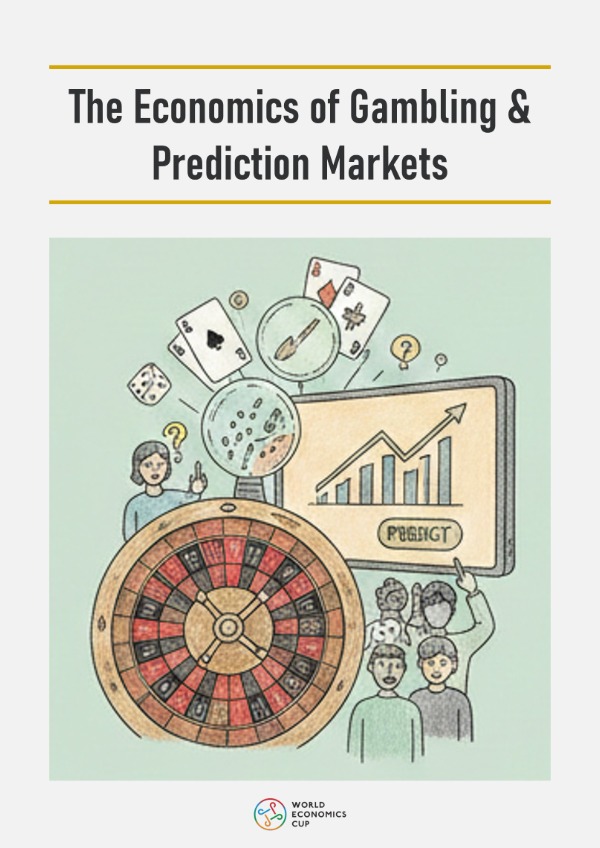
In this issue, we’ll explore the high-stakes world of gambling and prediction markets, analyzing whether betting can outperform expert forecasts—and what that reveals about decision-making under uncertainty. We’ll also examine surprising economic phenomena, from the hidden costs of queuing to the ripple effects of GLP-1 drugs, tying them to broader themes like market behavior and policy impacts. Get ready for lively discussions on everything from sovereign debt to the psychology behind all-you-can-eat buffets!

Economics magazineApplied price theory
Earn5CreditsinEconomics
11Modules16Sessions158Cards40Quizzes

Modules in this Collection’s System

Hover a module to read it directly

Big Question

Can betting markets predict the future better than experts? — the Iowa Electronic Markets, Polymarket's 2024 election call, and where prediction markets reliably fail.

1Session

Economist's Lens

Two micro-puzzles read through price theory — why countries go broke (the political economy of sovereign default), and why queues form when prices are held below market-clearing.

2Sessions

The Frontier

Three front-edge stories — Ozempic's macroeconomic spillover into food and airlines, the Lithium Triangle as the new Middle East of energy, and what Japan's 17 years of negative rates taught the world.

3Sessions

Everyday Life Economics

Two consumer-facing cases — why your streaming service keeps raising prices (the subscription trap), and why all-you-can-eat buffets are profitable despite seeming designed for the customer.

2Sessions

Economics Class

Two foundational principles — when the law meets the economist (introducing law & economics from Coase to Posner), and the economy as an ecosystem (introducing complexity economics).

2Sessions

Point vs. Counterpoint

Should prediction markets replace polls and expert forecasts? — what the 2024 election proved, what it didn't, and the live debate over regulation and manipulation risk.

1Session

Profile

Daron Acemoglu, the man who won the 2024 Nobel for explaining why nations fail — the institutions argument, the colonial-origins evidence, and what the work means for development policy.

1Session

The Case

FTX and the $32 billion disappearance — Sam Bankman-Fried's rise, the Alameda Research entanglement, the November 2022 collapse, and what regulators are doing differently in crypto's wake.

1Session

Lecture Hall

Tyler Cowen's 'What Do Prices Know That You Don't?' — Marginal Revolution University's clearest distillation of Hayek on the price system as decentralized information processor.

1Session

Read & Reflect

Richard Thaler's *Misbehaving* (2015) — the memoir-history-manifesto that traces behavioral economics from heretical sideline to mainstream tool with a Nobel attached.

1Session

Key Vocabulary

The issue's terminology card — prediction market, sovereign default, queue economics, NIRP, GLP-1 spillover, complexity economics, and the rest of the working vocabulary for this issue.

1Session

What You'll Walk Away With

  • 1prediction market field guide explaining when betting markets outperform experts, when they fail, and how Polymarket, Kalshi, and the IEM actually work
  • 1sovereign debt anatomy showing how defaults unfold (currency crisis → liquidity squeeze → restructuring), and the IMF's role through Argentina, Greece, and Sri Lanka
  • 1queue economics card distinguishing administered prices, lotteries, and waiting lines as alternative rationing mechanisms — with the welfare losses each implies
  • 1GLP-1 industry impact briefing mapping which sectors (food, alcohol, fashion, airlines) are being reshaped by mass weight-loss-drug adoption, and the market signals to watch
  • 1complexity economics primer introducing emergent dynamics, feedback loops, and agent-based models as the alternative to equilibrium-based macro

You'll Have Answers To

  • ?Can betting markets predict the future better than experts — and where do they reliably fail?
  • ?Why do countries default on sovereign debt even when they could technically pay — and how does the IMF actually restructure?
  • ?When prices are held below market-clearing, queues do the rationing — what's the welfare cost compared to letting prices clear?
  • ?How is Ozempic reshaping airline fuel demand, food retail, and even fashion — what does macroeconomic spillover from GLP-1s actually look like?
  • ?What did 17 years of Japanese negative interest rates actually teach the world's central banks?

Critical Concepts Explored

Prediction markets and information aggregationSovereign debt and default mechanicsQueue economics and price-below-clearing rationingGLP-1 drugs and macroeconomic spilloverLithium and critical-mineral geopoliticsNegative interest rate policy (NIRP)Subscription pricing trapsBuffet pricing and consumer overconfidenceLaw & economics (Coase, Posner)Complexity economics and emergent dynamics
Editor's Note
An issue that earns its 'beyond textbook' framing on every page

Issue 5 ranges from the macroeconomics of Ozempic to the political economy of sovereign debt to the moral psychology of prediction markets — without ever sacrificing analytical rigor. The FTX case study is the best concise treatment of crypto's biggest fraud in print; the Acemoglu profile lands the work that won him the 2024 Nobel; the Tyler Cowen lecture pick is unfailingly the right one.

Editor's Brief
Who it's for
World Economics Cup and NEC competitors, AP/IB Economics students, and readers who want a sharp current treatment of how prediction markets, sovereign debt, and pharmacological externalities are reshaping economies.
What stands out
The pairing of macro-scale stories (Japan rates, Lithium Triangle, GLP-1 spillover) with the micro-scale puzzles that make economics teachable (queues, buffets, streaming subscription traps) — both rigorous, neither superficial.
Read if
You want to understand why prediction markets sometimes embarrass the experts, why countries default even when they could pay, and why a weight-loss drug is reshaping the airline industry — all in one read.
Gold Quotes
Prediction markets often outperform experts on bounded questions like elections — but the record on complex geopolitics, slow-moving structural events, and rare disasters is uneven.

The Iowa Electronic Markets beat 75% of pollsters on US presidential elections from 1988 to 2008. Polymarket called Trump 2024 weeks before mainstream pollsters. But prediction markets failed badly on COVID-19 timing, on the Russia-Ukraine war's duration, and on Brexit's actual economic effects. The Hayek-style information-aggregation argument works best when the question is well-defined, outcomes resolve in months, and trader sample is large.

About the Curator
WWorld Economics Cup

Econ Beyond 2026 is World Economics Cup's flagship magazine series for LearningFirst — each issue takes one big question pulling at the global economy and works it through the discipline's full toolkit, from the Big Question essay down to the Key Vocabulary that lets readers explain it back. Built for learners preparing for the World Economics Cup, the National Economics Challenge, and any reader who wants their economic literacy current with the actual moment.