Econ Beyond 2026 Issue 2
Last revised 6/26/2026

Econ Beyond 2026 Issue 2

Secondary

How nations weaponize trade and finance — read alongside game theory, information asymmetry, and the everyday markets that shape behavior in unexpected ways.

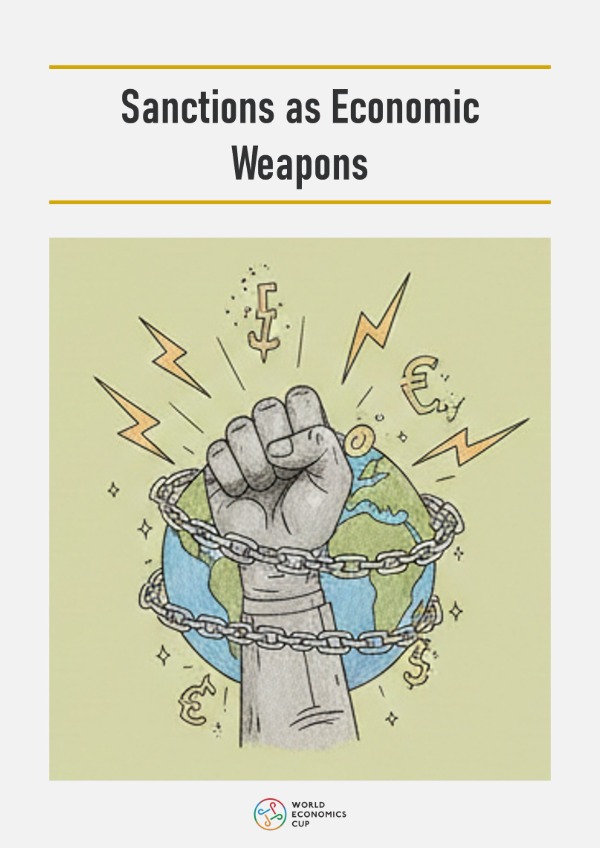
In this issue — Sanctions as Economic Weapons,' we’ll dissect how nations wield trade restrictions and financial pressure as tools of geopolitical strategy—without firing a shot. We’ll also explore unconventional economic forces, from the hidden costs of poverty to the psychology behind gym memberships, revealing how markets shape behavior in unexpected ways. By connecting theory to real-world examples like fast fashion and Argentina’s radical reforms, you’ll see economics as a dynamic weapon and a force of everyday life.

Economics magazineApplied price theory
Earn5CreditsinEconomics
11Modules16Sessions161Cards39Quizzes

Modules in this Collection’s System

Hover a module to read it directly

Big Question

Can you bomb an economy without dropping a single bomb? — the post-2022 Russia case as the textbook example of modern economic warfare via SWIFT, asset freezes, and trade controls.

1Session

Economist's Lens

Three micro-puzzles read through price theory — the hidden tax on being poor, how Zara killed the fashion calendar, and why your city has too many mattress stores.

3Sessions

The Frontier

Two front-edge stories — lab-grown meat hitting USDA-approved supermarket shelves, and Argentina's Milei experiment in real-time chainsaw libertarian macro.

2Sessions

Everyday Life Economics

Two consumer-facing cases — why your gym membership is designed for non-attendance, and the yield-management math behind wildly varying airline ticket prices for the same seat.

2Sessions

Economics Class

Two foundational principles — game theory as the math of standoffs (Nash, prisoner's dilemma), and information economics + the lemons problem (Akerlof).

2Sessions

Point vs. Counterpoint

Should governments break up Big Tech? — the Bork consumer-welfare standard vs. the new-Brandeisian case (Khan), and what 2026's antitrust enforcement actually targets.

1Session

Profile

Ngozi Okonjo-Iweala, the economist who runs global trade — the WTO Director-General's path from Nigerian finance ministry to the most powerful trade institution in the world.

1Session

The Case

The Theranos fraud — the textbook case of information asymmetry meeting Silicon Valley hype, and what happens when due diligence breaks at every level of the funding stack.

1Session

Lecture Hall

Barry Schwartz, 'The Paradox of Choice' (TED, 2005) — the talk that introduced choice overload to a popular audience and connected behavioral economics to consumer wellbeing.

1Session

Read & Reflect

Kate Raworth's *Doughnut Economics* (2017) — the book reframing economics around social foundation and ecological ceiling, and why heterodox frameworks matter even when they don't replace mainstream tools.

1Session

Key Vocabulary

The issue's terminology card — sanctions, lemons problem, Nash equilibrium, antitrust standards, vertical integration, behavioral pricing, and the rest of the working vocabulary for this issue's themes.

1Session

What You'll Walk Away With

  • 1sanctions toolkit map distinguishing trade restrictions, financial sanctions, secondary sanctions, and central-bank asset freezes — with the post-2022 Russia case showing each in action
  • 1game theory decision tree mapping prisoner's dilemma, coordination games, repeated games, and credible commitments to the real-world standoffs (sanctions, antitrust, labor negotiations) where they apply
  • 1information asymmetry diagnostic showing how the lemons problem, signaling, screening, and certification mechanisms restore broken markets
  • 1behavioral pricing field guide covering gym membership design, airline yield management, restaurant choice architecture, and the paradox of choice
  • 1Big Tech antitrust briefing comparing the consumer-welfare standard (Bork) and the new Brandeisians (Khan) on what constitutes monopoly harm in 2026

You'll Have Answers To

  • ?How do modern sanctions actually crater an economy — and do they achieve their stated political goals?
  • ?Why does the 'market for lemons' destroy markets even without fraud — and what mechanisms fix it?
  • ?What does Milei's chainsaw economics reveal about radical libertarian macro that smaller experiments couldn't?
  • ?Why are gym memberships and airline tickets designed around behavioral economics rather than rational choice?
  • ?Should governments break up Big Tech — and what's the difference between Bork's consumer-welfare standard and the new Brandeisians?

Critical Concepts Explored

Economic sanctions and SWIFT exclusionGame theory: Nash equilibrium, prisoner's dilemma, repeated gamesInformation asymmetry and the lemons problem (Akerlof)Signaling and screeningHidden costs of povertyVertical integration and supply-chain speed (Zara)Behavioral pricing and choice architectureYield management and price discriminationConsumer-welfare standard vs. new Brandeisians (antitrust)Heterodox frameworks: doughnut economics (Raworth)
Editor's Note
An issue that reads like the geopolitics-econ briefing you wished you had

Issue 2 makes good on its 'sanctions as weapons' framing while still finding room for game theory, the lemons problem, fast-fashion supply chains, and a sharp profile of WTO chief Ngozi Okonjo-Iweala. The Theranos and Argentina-Milei cases are particularly well-pitched — concrete, current, and tied directly to the textbook concepts they illustrate.

Editor's Brief
Who it's for
World Economics Cup and National Economics Challenge competitors, AP/IB Economics students, and general readers who want to read sanctions, antitrust, and consumer-fraud headlines through the actual mechanisms (game theory, information economics, behavioral pricing) at work.
What stands out
The pairing of macro-scale geoeconomics (sanctions, Argentina) with micro-scale consumer puzzles (gyms, airlines, mattress stores) — both treated with the same analytical seriousness.
Read if
You want one substantial read that connects the geopolitics of economic warfare to the price-theory tools that explain why the airport bottle of water costs $5.
Gold Quotes
Modern sanctions can crater a currency and an industry within weeks — without a single shot fired. The 2022 Russia case showed sanctions are now functionally a category of warfare, not just a diplomatic gesture.

SWIFT exclusion, central-bank reserves freeze, technology-export controls, and secondary sanctions on third-country buyers — combined, these tools dropped the Russian ruble 30% in a week, locked $300B in foreign reserves, and severed semiconductor supply within a month. Whether sanctions actually achieve their stated political goals is contested; that they impose massive economic damage is not.

About the Curator
WWorld Economics Cup

Econ Beyond 2026 is World Economics Cup's flagship magazine series for LearningFirst — each issue takes one big question pulling at the global economy and works it through the discipline's full toolkit, from the Big Question essay down to the Key Vocabulary that lets readers explain it back. Built for learners preparing for the World Economics Cup, the National Economics Challenge, and any reader who wants their economic literacy current with the actual moment.