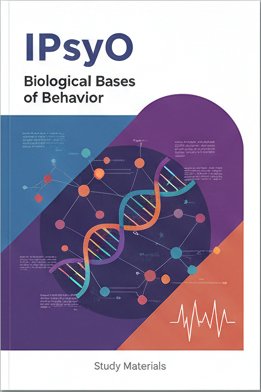
Biological Bases of Behavior
Last revised 5/20/2026

Biological Bases of Behavior

Secondary

How 86 billion neurons, a handful of neurotransmitters, and a few millimeters of cortex add up to mind and behavior.

This collection covers the biological foundations of behavior, including neuron structure and function, neurotransmission, the central and peripheral nervous systems, major neurotransmitters and their roles in behavior and disorders, brain imaging techniques, brain structures, and hemispheric specialization. Aligned with the IPsyO (International Psychology Olympiad) syllabus.

Academic primerNeuroscience foundations
Earn2CreditsinPsychology
3Modules9Sessions143Cards43Quizzes

Modules in this Collection’s System

Hover a module to read it directly

1. Structure and Function of the Nervous System

Neurons, synapses, and the CNS/PNS division — the wiring layer that everything psychological runs on.

Subscription-free content inside
3Sessions

2. Neurotransmitters and Their Functions

The chemistry of mind — which neurotransmitters do what, and which disorders track which imbalances.

Subscription-free content inside
3Sessions

3. The Brain and Behavior

From brain imaging to cortical geography — how researchers map living brains and what those maps reveal about behavior.

3Sessions

What You'll Walk Away With

  • 1neurotransmitter quick-reference pairing each major neurotransmitter (dopamine, serotonin, GABA, glutamate, acetylcholine, norepinephrine, endorphins) with its primary functions and the disorders linked to its imbalance
  • 1nervous system branch diagram mapping CNS vs. PNS and the somatic / autonomic / sympathetic / parasympathetic subdivisions with what each controls
  • 1imaging technique trade-off matrix comparing CT, MRI, fMRI, EEG, PET, and DTI on spatial resolution, temporal resolution, invasiveness, and typical use case
  • 1brain structure atlas card naming the hindbrain, midbrain, and forebrain regions and the behavioral consequences of damage to each
  • 1lateralization cheat sheet showing which functions lean left, which lean right, and what split-brain research does and doesn't prove

You'll Have Answers To

  • ?How does a 100-millivolt electrical pulse along a single neuron end up producing a thought, a decision, or an emotion?
  • ?Why do depression, Parkinson's, and schizophrenia track specific neurotransmitters — and why doesn't that make them purely chemical disorders?
  • ?When would a researcher reach for fMRI over EEG, or PET over MRI — what does each imaging technique actually see?
  • ?What does split-brain research genuinely prove about hemispheric specialization, and where does the 'left-brain/right-brain' pop story go wrong?
  • ?How can behavior be both *localized* (Broca's area for speech, hippocampus for new memory) and *distributed* (most complex behavior recruits networks)?

Critical Concepts Explored

Action potential and synaptic transmissionExcitatory vs. inhibitory neurotransmittersCNS vs. PNS; somatic vs. autonomic; sympathetic vs. parasympatheticDopamine, serotonin, GABA, glutamate, acetylcholine, norepinephrine, endorphinsStructural vs. functional brain imagingHindbrain, midbrain, forebrain organizationCortical lobes and their specializationsHemispheric lateralization and the corpus callosumLocalization vs. distributed processingNeural plasticity
Editor's Note
Neuroscience for psychology students, done right

A rare biological-bases primer that treats the nervous system as a working system, not a memorization chore. Neurotransmitters are tied to the disorders they explain; imaging techniques are contrasted on real trade-offs; hemispheric specialization is sharply separated from the pop-psych 'left-brain/right-brain' myth. IPsyO-grade rigor.

Editor's Brief
Who it's for
Students preparing for the International Psychology Olympiad, AP Psychology biological-bases unit, or any first-year psychology course that demands more than a surface pass through neuroscience.
What stands out
The collection keeps the biology tightly coupled to the behavior it produces — every neurotransmitter, brain region, and imaging technique is introduced alongside the psychological question it answers.
Read if
You want to stop guessing at questions like 'which imaging technique is best for this' or 'which neurotransmitter matters here' and start reasoning from first principles.
Gold Quotes
Every complex behavior is the product of electrical signaling along neurons and chemical signaling across synapses — together they form the bridge between biology and mind.

A neuron fires an all-or-nothing action potential down its axon; at the synapse, vesicles release neurotransmitters that cross to the next neuron's receptors and either excite or inhibit the next firing. This electrochemical handoff, repeated across 86 billion neurons and 100+ trillion synapses, is the mechanism underlying everything psychology studies.
About the Curator
IInternational Psychology Olympiad

International Psychology Olympiad is the editorial voice behind LearningFirst's IPsyO-aligned collections — producing rigorous, exam-ready primers on core psychological science for learners preparing for competitions and introductory university coursework.