Everyday Life Economics
Last revised 6/26/2026

Everyday Life Economics

Secondary

Five everyday markets, twenty-eight economic principles, one walking tour through how prices and incentives actually work.

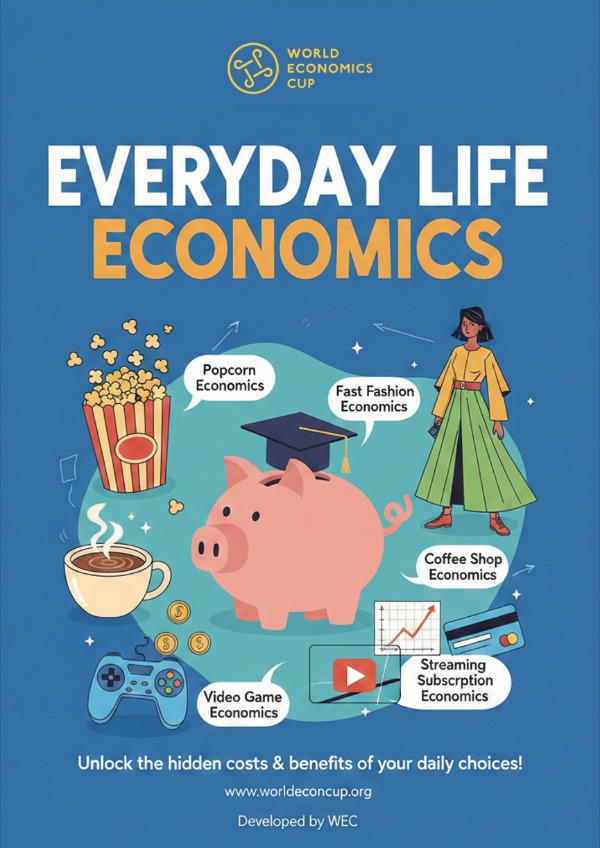
A walking tour through the everyday transactions most consumers never stop to examine — the popcorn that costs more than the ticket, the t-shirt that costs less than lunch, the subscription you forgot you had. Each section uses one familiar setting (movie theaters, fast fashion, coffee shops, video games, streaming) to teach the pricing strategies, market structures, and behavioral biases that explain why prices, products, and incentives actually work the way they do. Built for learners who want the economics behind the scenes — not the textbook before the scenes.

Applied microeconomicsConsumer economics primer
Earn4CreditsinEconomics
5Modules31Sessions216Cards62Quizzes

Modules in this Collection’s System

Hover a module to read it directly

Movie Theater Popcorn Economics

Why popcorn costs more than the ticket — two-part tariffs, captive markets, decoy pricing, loss leaders, and price elasticity, taught at the concession stand.

6Sessions

Fast Fashion Economics

Zara, Shein, and the speed game — vertical integration, artificial scarcity, inventory turnover, market structure, and the externalities that make the price tag possible.

6Sessions

Coffee Shop Economics

Inside the $5 latte — fixed vs. variable costs, cost-plus and value-based pricing, bundling, willingness-to-pay, loyalty programs, and the economies of scale chains exploit.

6Sessions

Video Game Economics

From box sales to free-to-play — business model evolution, freemium, microtransactions, battle passes, loot boxes, and the virtual economies inside today's biggest games.

6Sessions

Streaming Subscription Economics

Why your subscription stack quietly grew to seven services — tiered pricing, content as a moat, churn, customer retention, and how OTT/VOD disrupted the cable bundle.

7Sessions

What You'll Walk Away With

  • 1pricing strategy field guide covering two-part tariffs, price discrimination, decoy pricing, loss leaders, freemium, tiered pricing, and bundling — with the consumer-facing examples that make each visible
  • 1market structure decoder mapping perfect competition, monopolistic competition, oligopoly, and monopoly to how prices, profits, and innovation behave in each
  • 1behavioral economics playbook showing how decoy effect, scarcity framing, loss aversion, and anchoring are deployed at the concession stand, on the website, and in the app
  • 1subscription economics dashboard explaining churn, customer acquisition cost (CAC), customer lifetime value (LTV), and the ratios that decide whether a subscription business actually works
  • 1externality awareness card for spotting the social and environmental costs that markets routinely fail to price into the consumer transaction

You'll Have Answers To

  • ?Why does movie theater popcorn cost more than the movie ticket — and what does that tell you about pricing in general?
  • ?How can Zara sell a $20 dress in the same week the trend appears, and what's the economic engine behind that speed?
  • ?Why are loot boxes regulated as gambling in some countries — and what's the math that makes them work?
  • ?When Netflix raises its price by $2, why don't most subscribers cancel — and what does that reveal about price elasticity?
  • ?Why is recurring subscription revenue worth more than the same dollars in one-off sales?

Critical Concepts Explored

Two-part tariffs and price discriminationThe decoy effect and behavioral pricingLoss leaders and captive marketsPrice elasticity of demandVertical integration and inventory turnoverMarket structures: perfect competition, monopolistic, oligopoly, monopolyExternalities (positive and negative)Freemium, tiered pricing, and bundlingCustomer acquisition cost vs. lifetime valueChurn rate and recurring revenue
Editor's Note
Microeconomics taught the way it should be — at the concession stand

This collection makes good on a hard promise: teach price theory, market structure, behavioral biases, and externalities without the textbook lifting. Five everyday consumer markets — popcorn, fast fashion, coffee, video games, streaming — each become a case for the principles they exhibit. Concrete, current, and refreshingly free of the rote definitions that make most intro econ unreadable.

Editor's Brief
Who it's for
Students preparing for the World Economics Cup, the National Economics Challenge, or any introductory microeconomics course where applied examples beat abstract definitions — plus anyone who wants to read a menu, a streaming-tier page, or an app paywall and see the strategy.
What stands out
The collection refuses to teach economic principles in the abstract — every concept arrives with a consumer-facing example you've already lived through, and the example does the explanatory work the textbook would have done.
Read if
You want the same vocabulary economists use to explain why popcorn costs $8 and Netflix costs $15 — and you'd rather walk through five real markets than memorize a glossary.
Gold Quotes
Movie popcorn isn't expensive because it's expensive to make. It's expensive because the theater owns a captive market — and captive markets license the kind of markup competitive markets won't tolerate.

Once you've bought a ticket and walked into the theater, you cannot pop down the street for cheaper popcorn. The theater knows this; you know this; the price reflects it. It's the same logic behind airport food, in-stadium beer, and in-app purchases — the seller temporarily owns the only supply, and the price climbs to what the captured buyer will tolerate, not what the input costs justify.

About the Curator
WWorld Economics Cup

World Economics Cup is the editorial voice behind LearningFirst's economics collections — translating consumer-facing markets and global economic forces into rigorous, observational primers for learners preparing for competitions, university coursework, and the everyday work of being an economically literate person.